Editor's Review:
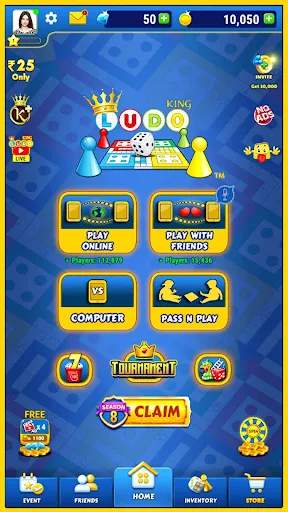
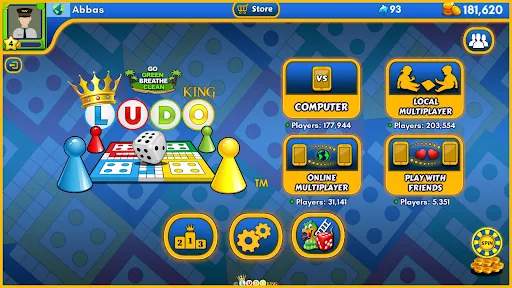
Ludo King is a multiplayer strategy board game that is inspired by the traditional Indian game Pachisi. It combines the randomness of dice, the choice of movement routes for the pieces, the psychological games between players, and the instant decision-making, allowing you to constantly think about how to win in a seemingly easy battle. Just as Sun Tzu said in The Art of War, "The winner takes the initiative before seeking battle." This idea perfectly reflects the core experience of Ludo King, because you will find that truly skilled players do not rely on luck at every step, but have already thought out several possible ways of response before the dice fall. In Ludo King, struggling to win is almost present in each round. You may not get the ideal point for several consecutive rounds, or you may just have moved your piece to a critical position, only to be eaten by your opponent. At this time, the most interesting part of the game emerges: you will not always blame others, nor will you only complain about bad luck, but will gradually develop the habit of seeking solutions. You will start to think, "Was it too aggressive this time? Should I protect the subsequent pieces first, or can I choose a more stable route?" It forces you to shift your attention from emotions to the problem itself. When the situation becomes stalemate, you may experience a moment of pause. You stare at the board, while simultaneously calculating the position of your pieces, the possible landing points of your opponent, the distance to the safe zone, and the risk of being eaten next.
In that instant, the outside world seems to be silent. Your prefrontal cortex is fully activated because you need to handle planning, judgment, risk control, and goal selection. Although it seems to be just rolling dice and moving pieces, when you really get into it, you will find that this is actually a high-intensity mental training. The most enjoyable moment is when your strategy really takes effect. For example, you deliberately wait for one round, and as a result, your opponent happens to enter your attack range; or you do not rush to the finish line but instead place another piece in a safe position, and finally successfully overtake. That feeling is very good because you know it is not just pure luck, but the result of your correct judgment. Whenever such moments occur, you will feel that you are very smart and will also believe more in your analytical ability. Ludo King also has an easily overlooked aspect, which is that your attitude will affect other players. If you show panic when you are in a disadvantageous position, your opponent will be more daring to press on you; but if you remain calm and even pretend that you still have a backhand, your opponent may hesitate. Sometimes, you really need to "fake it", even if the situation is very difficult, you still need to act calmly. This psychological contest makes the game not just about moving pieces, but more like a small negotiation.
Of course, this game will also cause your emotions to change instantly. A six-point can turn you from a passive position to an active one, and a single wrong move might also cause your advantage to collapse. Therefore, you must have a flexible mindset. You cannot become complacent because of temporary success, nor should you deny yourself because of a single mistake. If you find yourself going in the wrong direction, you must stop immediately and adjust to a more correct decision. True progress often comes from this timely correction. After playing for a long time, you will start to learn from your mistakes. You will remember which positions cannot be stopped at will, when to disperse the pieces, when to concentrate on advancing, and when to be conservative and retreat. Gradually, you will have a deeper insight and even be able to anticipate what your opponent will do next. While you are playing this game, you will notice that this game can truly become a mirror reflecting different player's character. You will clearly see how your family members deal with a crisis. When you are playing this game together, you will immediately see whether or not one of your family members has the true psychological resilience, especially when he or she is faced with a fatal blow, when he or she has no other choice, and when his or her pieces are sent back to the starting point. One moment, this family member is so close to the destination, but in the blink of an eye, he or she is sent back to the starting point. So this sharp contrast from the top to the bottom can best show whether or not a person has the resilience in the face of sudden changes and disasters.
You will find that some players can quickly calm down and search for the optimal path for the next piece, which indicates that they are often someone who stays calm under pressure in the real crisis situations, while others may get stuck in prolonged complaints or depression. This actually reminds us that when they encounter setbacks in life, they may need more emotional support and buffer space from their families. From the strategic layout of the game, we can clearly observe the values of family members in resource management and risk control. Some players are accustomed to proceeding step by step within the "safe zone", even if the progress is slow, they ensure that everything is foolproof. So, when they are faced with unpredictability and uncertainty, you can see that they prefer to handle the challenge in a more conservative way by minimizing risks, and their priority is to protect the existing achievements. On the contrary, those who prefer to take the risk of being "eaten" themselves rather than actively attacking and sniping their opponents often possess strong proactive aggressiveness and adaptability. They tend to break the deadlock and resolve their crises by changing the external environment. Moreover, the overall scheduling of the four pieces reflects the family member's overall perspective and multi-tasking ability. Is it to place one piece first in a "safe zone" or for all pieces to move together and support each other?
This understanding of "not putting all eggs in one basket" determines their rationality in family resource allocation or dealing with complex matters. A family member who knows to leave a "backup plan" in the game is often a reliable partner with meticulous thinking and always ready with Plan B in real life. Observing through this general perspective, we can better understand the blind spots and strengths of different family members while we are playing. At last, the small decisions made by different family members make you understand that when there are conflicts or resource competition within the family, who is more inclined to "reason" and who is more inclined to "empathy". This deep insight based on the game not only dispels the dullness of the festival but also teaches us how to collaborate with each other in future real-life situations in a way that best suits different family member's personalities.