Editor's Review:
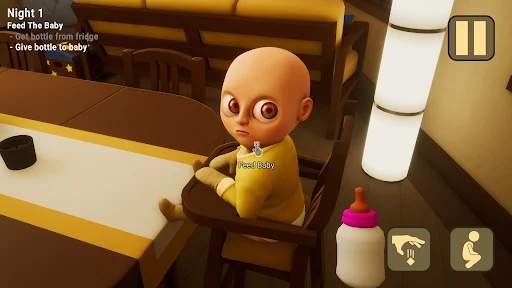
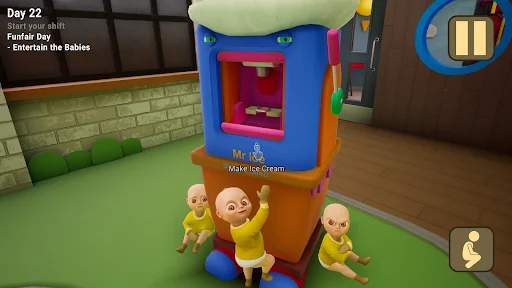
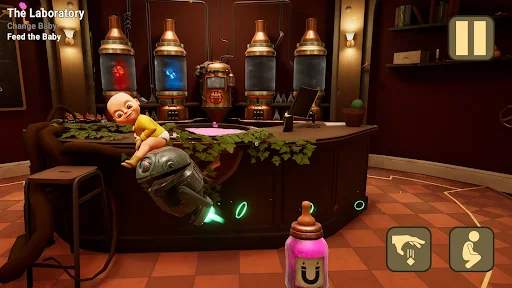
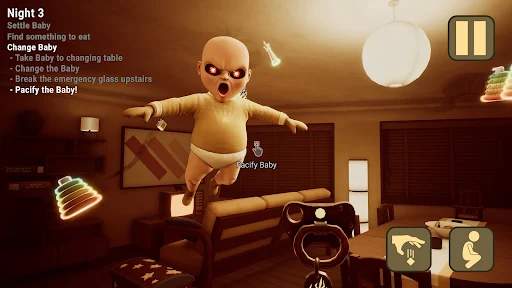
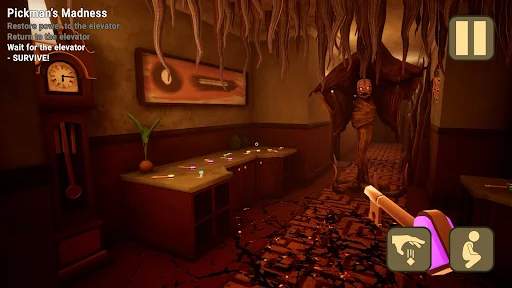
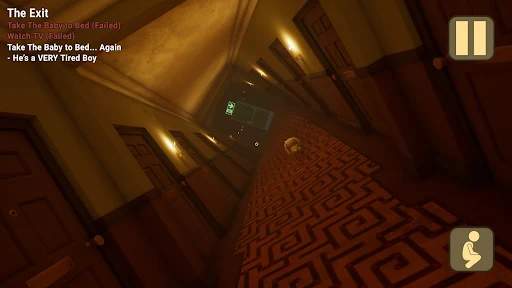
The Baby In Yellow is a first-person indie game that combines elements of horror, survival, and light puzzles. The Baby In Yellow looks like a slightly mischievous parenting simulation at first glance: you are just a temporary babysitter whose tasks are nothing more than feeding, changing diapers, and putting the baby to sleep. But as the night falls, this "baby" gradually becomes abnormal, and the genre of the game quietly shifts from everyday simulation to psychological thriller. The best part of the game is its control of pacing. It does not begin with jump scares to overwhelm the player. Instead, it builds a sense of security through repetitive daily routines. You get used to going to the kitchen to get the bottle, putting the baby in the crib, turning off the lights, and leaving the room. Once this mechanical process is broken, for instance, when the child suddenly disappears, the door locks for no reason, or the television automatically plays disturbing images, players instinctively feel uneasy. The developers clearly understand the design of "delayed fear," not aiming to scare you directly, but to make you realize that something is wrong. In terms of visual style, The Baby In Yellow does not aim for realism, but instead uses slightly cartoonish models and exaggerated expressions. Those empty and slightly dull eyes are one of the most effective horror symbols in the entire game.
The baby is supposed to represent innocence, but here it becomes a source of uncertainty and threat. This contrast itself creates a psychological sense of unease. Although the content is not complex, it elevate your game experience from simple childcare to a complete horror narrative. In addition, the AI behavior is essentially script-driven, and the sense of horror decreases once you becomes familiar with it. If you are tired of horror games that rely solely on loud sounds and visual shocks, this game offers a more subtle and psychological form of fear, not to startle you, but to make you hesitate for a second every time you open a door. From a deeper perspective, The Baby in Yellow is not merely a horror game; it somehow evokes our inner authenticity. In real life, we often deliberately disguise our emotions, especially in social situations, where we frequently hide our true reactions to conform to others or follow social norms. And precisely in this extreme strangeness and unease, you can see your true self more clearly, including your inner fears, curiosity and resistance. And even your inner struggles are magnified, making you realize emotions you may have never truly faced before. What is more interesting is that this game makes you realize that humans may not always prefer comfort and safety as much as we think. Many people are used to staying in familiar environments, believing this is the most natural choice, but The Baby in Yellow uses its counter-intuitive and unnatural settings to reveal that people may also have an instinctive longing for the unknown, for fear, and for broken boundaries. You might think you would avoid such unknown horrors, but in reality, you may also find genuine stimulation and emotional responses in this unease and uncertainty, and it is this loss of control that makes you feel your most authentic existence.
In that extremely tense and uneasy moment, you might feel as if you are on the verge of breaking, yet strangely, it is this extreme state that brings an unprecedented sense of release. You begin to experience this out-of-control feeling differently and may even, at times, actively seek the "forbidden zone," hoping to break through mental constraints and explore things considered abnormal. Because in these abnormal experiences, you are able to feel your true self. This extreme horror experience also allows you to regain self-awareness in a state of losing control, and dealing with abnormal situations can actually bring a sense of relaxation and release. In a world that feels full of anomalies and threats, you begin to face yourself and perceive the emotions buried deep within, those often suppressed by society and overlooked by reason, and which is the most profound experience that The Baby in Yellow offers! Moreover, this terrifying baby will not truly disappear when you shut down the computer or finish the game. Instead, its shadow will continue to exist in your consciousness in another way. You might recall it unexpectedly at any moment, while doing housework, when walking alone, or even during the brief moments of waiting for the elevator. Suddenly, it will intrude into your mind.
What is more interesting is that you do not merely recall it passively, but start unconsciously "continuing" its story. You will imagine how it would look like if it were in reality, whether it would still stare at you with that unusually calm yet eerie gaze, whether it would disappear in an instant when you turn around, or reappear in some illogical corner. These constantly emerging images are essentially your psychological projection of this character. You extend the unease and the unknown from the game to the thinking space of reality. However, even though you clearly know that these are merely your mental projections, the brain's re-creation between familiarity and strangeness, this "self-directed and self-performing" fear does not weaken; instead, it becomes even more vivid. Because during this process, terror is no longer an external imposed stimulus, but transformed into an experience constructed by you actively. No matter whether you create a more extreme, uncontrollable version of terror, or an existence with certain rules and logic, you will experience an inexplicable excitement in this creation. This is precisely the deeper charm of The Baby in Yellow. It not only breaks your psychological boundaries during the game but also keeps your consciousness in that "unfinished" state after the game ends, blurring the boundary between reality and fiction.
You start to experience a slight but continuous tension in your daily life, this tension coming from both fear and the expansion of imagination. You know that everything is fictional, yet you cannot help approaching this uncertainty, even enjoying it to some extent. From a deeper perspective, this phenomenon actually reflects a special mechanism of human consciousness. We are not content with passively accepting stimuli; instead, we will actively continue, amplify, or even distort those experiences that trigger strong emotions. Thus, terror is no longer just "being experienced", but "being created". In this continuous generation and reconstruction process, what you confront is no longer just the baby in the game but your exploration of the relationship with the unknown. And in this seemingly uneasy cycle, you actually gain a peculiar sense of clarity and reality. In the abnormal world of The Baby in Yellow, what you feel is not just fear itself, but an unprecedented sense of power that gradually emerges from within that fear. The rules of this world are chaotic, scenes change suddenly, order collapses silently, and that seemingly weak baby constantly challenges your judgment and reason in supernatural ways, as if forcing you to confront what is out of control, the unknown, and the deepest unease in your heart at every moment. But it is through this process that you begin to realize that you are not breaking down as easily as you might have imagined. You move through the chaos, but you are not truly crushed by it.
What makes The Baby in Yellow so special is that it does not simply make you afraid. While making you afraid, it also teaches you how to maintain stability within instability, how to reorganize your perception when logic is shattered, and how to preserve a certain core judgment when you are on the verge of losing emotional control. Then you begin to realize that what truly makes you feel powerful is not that you have conquered the world, but that within it, you have gradually shaped a mind that is not easily shaken. You begin to understand that clarity does not necessarily arise from calmness; often, the deepest awareness comes precisely from chaos itself. When everything around you becomes unreliable and unpredictable, you are forced to move closer to your inner self and determine what your true feelings are, what your real reactions are, and what you are still able to hold onto even in extreme situations. In this sense, the experience brought by The Baby in Yellow goes beyond the realm of a traditional horror game; it feels more like a test of psychological resilience. You do not overcome those strange moments by luck, nor do you avoid collapse because of numbness. Rather, by facing absurdity again and again, you gradually establish a firmer, calmer, and more unshakable sense of self-awareness. The more that baby creates anomalies, the more clearly you are able to see the outline of your own mind within that abnormality; the more that world tries to make you lose control, the more likely you are to feel a force rising from the depths of your heart through that confrontation. In the end, you will discover that what is truly fascinating is not just the horror itself, but the fact that within that horror, you are able to gradually build an almost unshakable inner order, and this, perhaps, is the deepest and most addictive aspect of The Baby in Yellow!