Editor's Review:
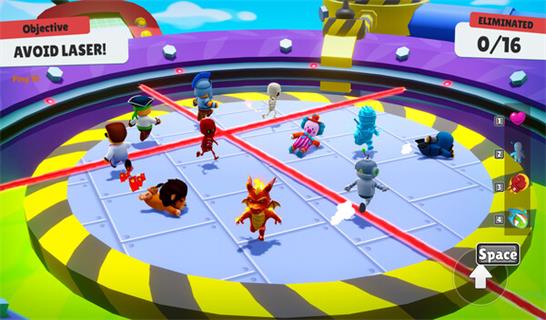
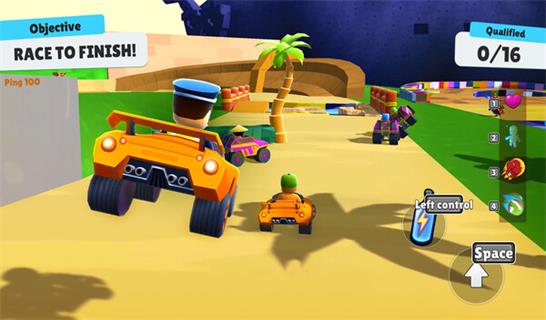
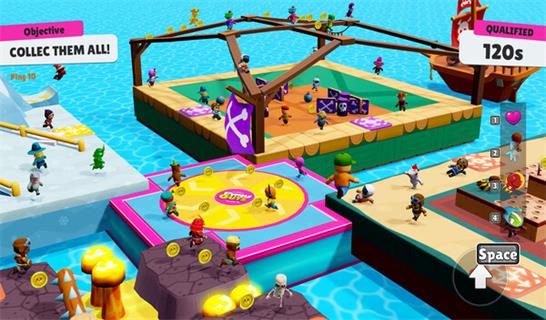
Stumble Guys on Steam is a multiplayer party game, and its core experience is built around up to thirty two players running, jumping, colliding, making mistakes, and trying to become the final winner. You should not treat it as an ordinary casual game just because its controls are simple. Once you enter a match, you will realize that every second can change the result. You may be running at the front, yet another player beside you can push you off the platform. You may start at the back, yet a group of players in front of you may all fail at the same time, giving you the chance to cross the line first. This kind of chaos with constant reversals is the core entertainment value of the game. This game brings out your most direct human instinct for play. You run, compete, fall, laugh, and start another round. When you play it, you rarely enter a heavy state of thought. More often, you are laughing, rushing, feeling annoyed, or hitting the table because of one mistake right before the finish line. The core rules of the game are very simple. There are up to thirty two players enter a level together, and you will try to glide through obstacles and chaotic collisions until the final winner is decided. Because the rules are so easy to understand, the game can quickly stimulate your desire to win. When you lose a round, you usually do not feel that victory is impossible. Instead, you think that you could have avoided that one hit, or that you definitely would not jump too early next time. This mental loop is very important. It lowers the pain of failure, but makes the next round more tempting.
In terms of controls, it is also quite simple. What you mainly need to do is move, jump, dash, and judge the route. But this does not mean that the game has no skill involved. After playing for a while, you will realize that it tests your ability to maintain control continuously. You need to control the character, and you also need to control your emotions. You need to know when to take the inside route, when to avoid the crowd, when to wait for a mechanism to pass, and when to take a risky dash. As long as you can control yourself well in every second, you will be closer to winning. This idea of control is not empty talk, because many failures do not happen because you do not know how to play. They happen because you are too impatient, too greedy, too early in celebrating, or too careless when you are already ahead. Besides, this game is very suitable for fragmented time. When you are waiting for friends to come online, taking a short break between classes, or finishing work and not wanting to play anything too tiring, you can join this party. It does not make you feel mentally exhausted. The rhythm is short, the feedback is quick, and the cost of failure is low. If you lose, you can immediately start again. It may not keep you immersed for an entire night, but it can give you clear joy and excitement in a short period of time.
However, the Steam version also has an interesting contradiction. On mobile, this simple and direct design feels very natural, because mobile players are already used to short matches, low barriers, and quick feedback. But once it is placed on PC, you may naturally compare it with multiplayer party games that are more complete and richer in content. Keyboard and mouse or controller input does feel more stable, and a larger screen makes it easier to observe routes. Still, PC players often have higher expectations for content depth, physical feedback, number of levels, and long-term progression. As a result, both the strengths and weaknesses of Stumble Guys on Steam become more obvious. It is relaxing, direct, and easy to understand, but the depth of systems is also limited. This is a perfect game to play with friends. It provides a social space with low pressure and many funny moments. You can run through levels while talking on voice chat, tell each other the timing of mechanisms, or simply enjoy watching someone else fail. The winner gets to show off, the loser gets to make excuses, and the spectators get plenty of reasons to laugh. The social value of the game does not come from completing a complicated shared objective. It comes from the fact that every round naturally creates new things to talk about. The more friends you have, the more chaotic the scene becomes, and the easier it is for the fun to grow. You will slowly fall in love with the uncertainty of this world. Many competitive games pursue stability, where stronger technique makes the result more predictable.
But Stumble Guys deliberately keeps the situation unstable. Maybe you look like the fastest player at the beginning, but you may not even reach the finish line. Maybe you start at the very back, but because others keep making mistakes, you end up crossing the line first. It reminds you never to become too proud, and never to give up just because you are temporarily behind. As long as you have not been eliminated, the match is not over. This design gives every round suspense and makes every comeback especially satisfying. Of course, it is not a perfect game. First, the sense of freshness can fade rather quickly. If you play for a long time without stopping, you will find that most of the fun comes from chaos, mechanisms, and interaction with friends, rather than deep progression. Second, the ceiling of skill is not especially high. You can improve your win rate by becoming familiar with maps, but it will not give you a large number of technical details to study like a hardcore action game. In addition, collision and network conditions can sometimes affect the experience. You may feel that you did not touch an obstacle, yet still get pushed away. You may also lose a good route because the bodies of other players block your movement. As a free game, you can easily invite friends to download it and play together. But free games usually build spending systems around skins, events, rewards, and passes. If you only play casually, these things will not affect the core experience too much.
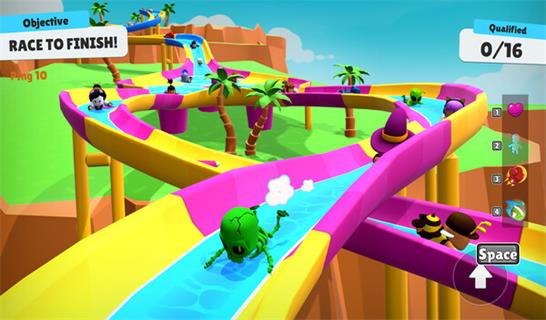
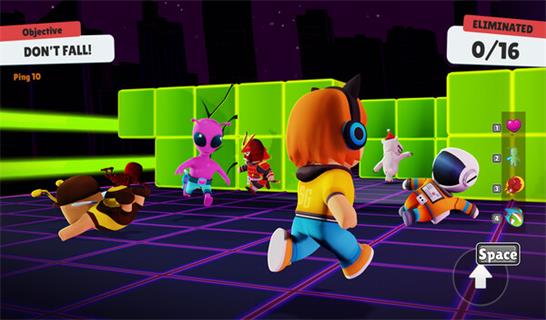
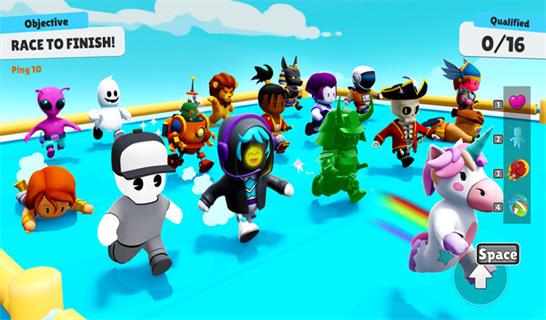
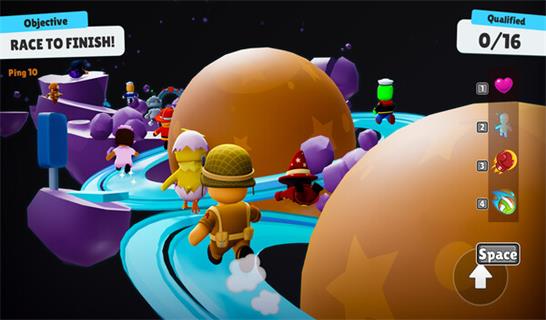
If you care a lot about collecting appearances, you will clearly feel that the game often reminds you to pay attention to outfits and rewards. Fortunately, winning or losing does not depend on payment. You can still join matches and win normally without spending none. The characters in this world are cute, the movements are exaggerated, and the maps are full of colorful scenes. The visual goal is clear, which is to fall, crash and enjoy yourself. It is not a game that pursues detailed models or realistic physics. You do not feel too heavy when you are knocked into the air, because the visuals themselves tell you that this is a ridiculous party, not a serious competition. Overall, Stumble Guys on Steam is a party competition game with a clear identity and quick rhythm. Its strengths are simple rules, suitability for fragmented time, good multiplayer effects with friends, and entertaining reversals created by uncertainty. Its weaknesses are limited long-term depth. Still, it is worth trying. Its real charm lies in that it lets you experience leading, failing, turning the match around, getting eliminated, and laughing within only a few minutes. You may be furious because you fall right before the finish line, or you may somehow win because everyone else fails at the same time. Stumble Guys shows that chaos itself can become a form of fun. As long as you are willing to accept this uncertainty and control yourself well in every second, it can give you a very direct, relaxing, and addictive kind of happiness!