Editor's Review:
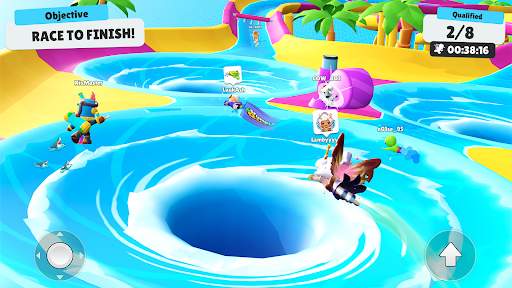
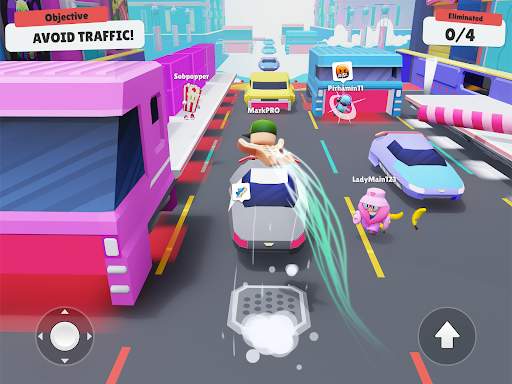
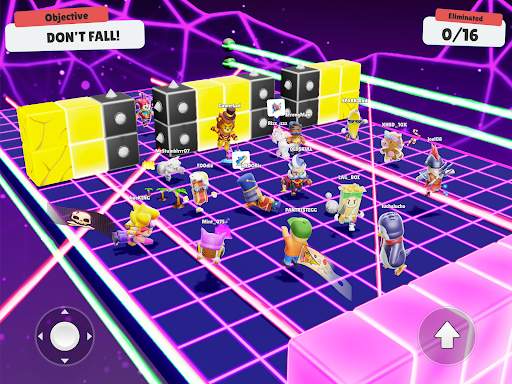
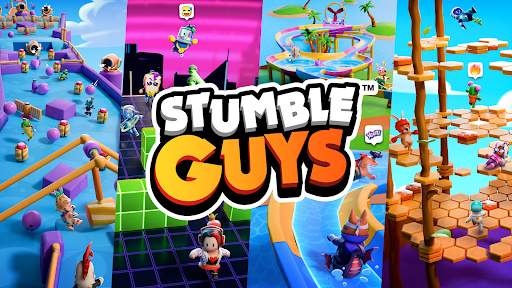
Stumble Guys is a casual multiplayer party battle royale game. At first glance, this game might seem like a simple party game. However, after playing it for a while, you will find that it is not merely an imitation of traditional party games, but has developed its own rhythm. Its core gameplay is very straightforward. Dozens of players enter different levels simultaneously and are eliminated in chaos until the last person remains the winner. It is precisely this combination of "simple rules and high randomness" that gives the game an appeal that is difficult to measure by traditional competitive standards. The most obvious feeling is that the game almost takes "loss of control" as its core design. The movements of the characters are slightly clumsy, and the collision detection sometimes even carries a sense of humor. You may think you find your balance, but suddenly you are pushed down by someone next to you with a slight bump; or you are running ahead with effort, only to be sent back to the starting point by a rolling obstacle. This experience, if placed in a serious competitive game, might be considered "unfair", but in Stumble Guys, it becomes a source of fun. Because all players are struggling in the same chaos, no one can fully control the situation, so winning and losing become less important, and the process itself becomes more memorable.
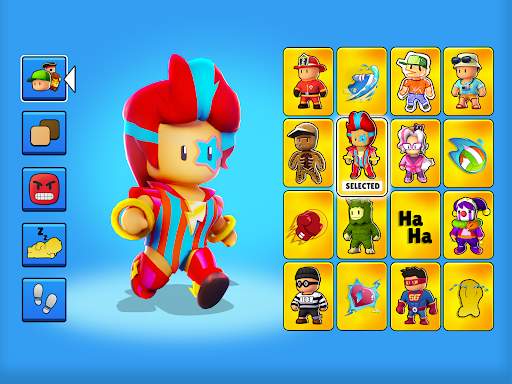
From the perspective of level design, the game introduces rhythm variations based on the repeated actions of "run, jump, avoid, and squeeze". Some levels emphasize path selection, some levels will test reaction speed, and others are closer to pure chaos. You will find that sometimes some useful skills can indeed help you pass more consistently, such as becoming familiar with the rhythm of mechanisms and mastering the timing of jumps; however, more often, the outcome is still affected by unexpected factors, such as congestion on your way ahead, physical collisions, or even network delays. This state of unpredictability actually reduces your frustration because it is difficult to attribute failure entirely to yourself. The social aspect is also one of the reasons why this game is addictive. Besides, it does not require as much communication as traditional team games, yet it is naturally suitable for playing with friends. You can deceive each other, block each other's path, or push forward together at critical moments. Especially during parties or fragmented time, it is almost a game that "you can start at any time and quickly laugh out loud". Most of the time, what you remember is not who won, but who was knocked off in a ridiculous way in a certain level, or who fell over right before the finish line. However, this game is not without problems. After playing for a long time, you will clearly notice the issue of repetitive content. The variations in some levels are limited. And after playing them many times, there will be a sense of fatigue, as if "it is always the same map". Additionally, skins, expressions, and some paid content show a certain level of commercialization in the later stages. If you pay attention to these appearance systems, you may feel a slight sense of "being pushed to spend". But if it is regarded simply as a light entertainment game, these problems do not greatly affect the core experience.
What is more interesting is that the appeal of Stumble Guys does not entirely come from "winning", but rather from continuous small bursts of stimulation and uncertainty. You may be eliminated in several consecutive rounds, but in the next round, you might suddenly advance smoothly to the end and even win the championship. This contrast makes it easy for you to start another round. It is not like traditional competitive games, which emphasize growth curves and technical accumulation, but is more like an emotion-driven cycle: chaos - failure - another round - occasional success - continue the chaos. From an overall perspective, Stumble Guys is a very typical party-style game. It does not pursue absolute fairness, nor does it emphasize advanced skills. Instead, it focuses on immediate feedback, random events, and group interaction. What you experience is not rigorous competition, but a kind of slightly absurd and potentially disastrous joy. If there is anything it truly does well, it is turning "failure" into something acceptable and even enjoyable. When you fall, you might complain a little, but the next moment, seeing someone else get eliminated in an even more ridiculous way, you cannot help but laugh. This emotional back-and-forth is where its core charm lies.
C.G. Jung once said that "The greatest privilege in life is to become your true self". And Stumble Guys, a seemingly easy, chaotic, and even somewhat absurd game, provides, in a sense, a space for a brief return to the true self. As you play and laugh in this world full of collisions, falls, loss of control, and accidents, you suddenly feel that the disguises you wear in reality to adapt to rules, please others, and maintain dignity are falling away little by little. You no longer need to act mature, rational, or strong, or constantly think about efficiency, results, and winning or losing. You simply throw yourself into it, running, falling, and getting up again like a child, and even failure no longer seems heavy. In Stumble Guys, failure is not a disgrace that must be concealed. Instead, it often appears in a comical, exaggerated, almost theatrical way: you might be knocked down by a slight bump near the finish line, or sent back to the starting point by a mechanism when you were almost certain to succeed. It is precisely because this kind of failure is accidental and absurd that it is no longer just a denial of ability, but rather an experience that can be accepted and even enjoyed.
You will also find that in this world, the absence of support is not a disadvantage, because you still have luck to rely on. Here, luck is not a weakening of strength, but the key to keeping the whole process alive and open. Without luck, without those unpredictable collisions, deviations, and unexpected situations, everything would become overly certain, and the outcome would be completely calculated and controlled. Even if you won, it might still feel empty and dull, because all you would get is a predetermined answer rather than a truly exciting experience. It is precisely within this uncertainty that another, more instinctive kind of strength begins to emerge. When you are in a very happy and relaxed state, even without support, things that once seemed impossible can suddenly become possible. You do not stop for too long to weigh everything carefully because of a lack of security. Instead, you keep moving forward with an almost primal impulse, pushing through with raw force, trying to carve out a path in the chaos. Therefore, the charm of Stumble Guys is far more than the superficial joy it brings. It is more like a reminder that what truly makes you feel relaxed and happy is not always being right, always being successful, or always being supported, but being in a space that allows chaos, chance, and failure, where you no longer have to work so hard to play someone else, and can instead simply be yourself. The state of laughing in absurdity, continuing to move forward after falling, and still being willing to devote all your passion in the midst of uncertainty is perhaps the moment when you are closest to the true self.
Many people habitually believe that confidence is a quality that naturally grows from within, as if simply telling oneself "I can" over and over will make a person truly strong and resilient. However, in reality, truly stable confidence is often not born out of thin air. It usually comes from a long history of external validation that is eventually internalized. In other words, the reason a person comes to believe in himself is often that he has repeatedly received responses, acceptance, and recognition from the outside world, and only then do these external signals gradually solidify into inner certainty. Stumble Guys provides precisely this kind of very special psychological space. In this game, you do not need to present yourself in a "perfect" way, nor do you need to follow a highly serious or fixed standard of success, because the world itself is chaotic, exaggerated, and full of randomness. You might fall in an extremely comical posture, or be knocked off the platform because of a ridiculous mistake, but it is exactly in such a seemingly chaotic situation that you do not feel ashamed. Because everyone is experiencing the same chaos, everyone may make mistakes, fail, or stumble, so absurdity no longer means failure, but instead becomes a way of existence that is quietly accepted. In such an environment, the "approval" of other players does not necessarily appear as direct verbal praise, but more as a collective atmosphere: you are allowed to make mistakes, to look comical, to act unconventionally, and even your exaggerated performance itself becomes part of the fun of the game.
Over time, you begin to find that you are less afraid of making mistakes, less concerned with whether you look respectable enough, and more willing to try, to take risks, and to charge boldly into uncertainty. Because you know that even if the result is absurd, you will not be completely rejected, and you can still remain within this joyful, chaotic, and inclusive space. As a result, a very interesting change takes place: at first, what you rely on is the tolerance and acceptance given by the external environment, but gradually, this acceptance is absorbed into your inner self and becomes a new form of self-perception. You begin to believe that you do not have to be always correct in order to be accepted; you do not have to be always stable in order to keep moving forward; and you do not have to conform to a single standard in order to have a sense of presence and action. From this perspective, Stumble Guys is no longer simply a form of light entertainment. It is more like a way of showing people that confidence does not necessarily arise from isolated inner reflection, but often grows out of a world that allows you to fall, allows you to be exaggerated, allows you to be absurd, and still accepts you. When you remain in such an environment for a long time, you will naturally become bolder and more confident, because you no longer see "making a mistake" as the collapse of self-worth, but instead as a way of expressing yourself, truly participating in the world, and even creating happiness!