Editor's Review:
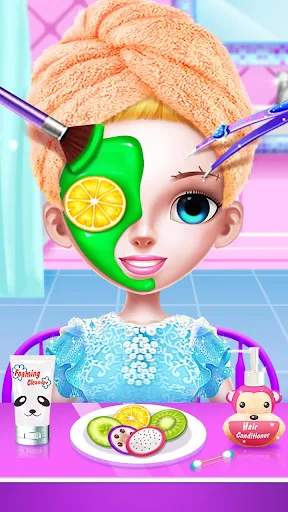
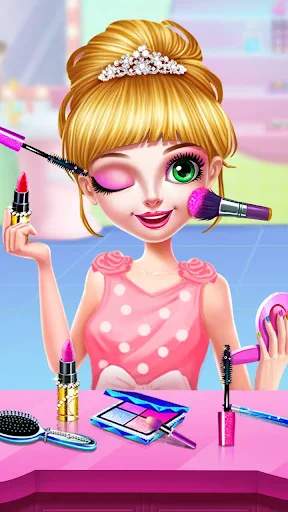
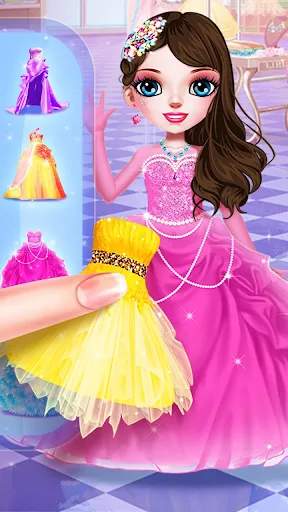
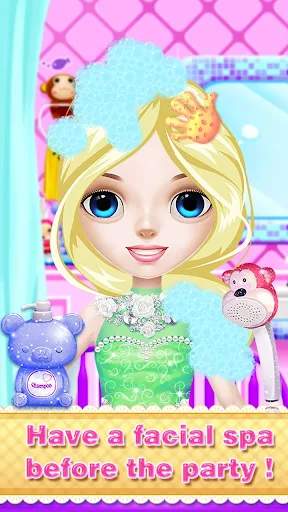
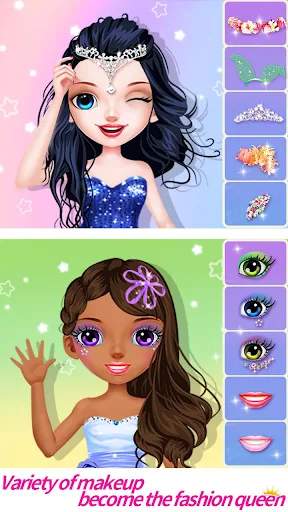
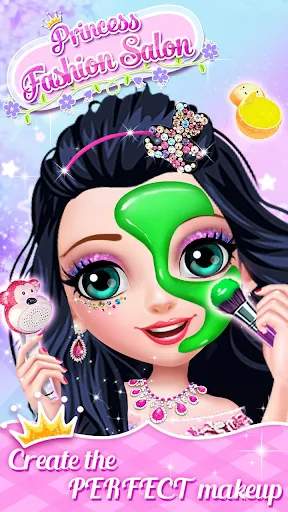
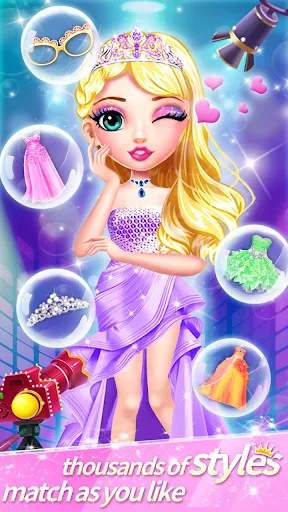
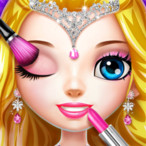
Princess Makeup Salon is a casual dress-up and makeup simulation game. When you first enter this world, you might think of it as a "tap-tap makeup toy" only for younger players, but once you get the hang of it, you will find that it is not just about putting on lipstick, eye shadow, hairstyles, and skirts one by one. It breaks down the process of dressing up into a lightweight, visual, almost effortless aesthetic experience: from basic care, facial cleansing, and hair styling to makeup matching, outfit selection, and background photography, the whole process feels like slowly turning a simple fairy-tale imagination into a finished creation that can be displayed. Princess Makeup Salon divides its gameplay into care, makeup, dress-up, and photo-taking, and emphasizes core elements such as character selection, accessory matching, hairstyle design, and saving photos. Its first advantage is that it truly understands the idea of immediate feedback. While many big-budget games use task rewards, plot progression, and character growth to engage players, Princess Makeup Salon uses a much more direct reward system: when you change a hairstyle, the character's whole temperament changes immediately; when you adjust the eye makeup, the overall style instantly leans toward sweet, glamorous, or mature; when you switch into a new dress, the visual balance of the whole picture changes as well. The feedback is so quick that there is almost no barrier to understanding it, so it feels less like a traditional challenge-based game and more like a visual toy box that can be opened at any time.
You do not experience intense frustration, and you are not blocked by complex systems. Instead, it feels light and fluid, almost like repeatedly asking yourself, "If I wanted to turn this princess into a completely different person today, what would she look like?" From this perspective, it is not selling control or plot, but a low-pressure creative impulse. However, what really makes this game interesting is more than just having plenty of items, bright colors, and beautiful characters. It actually relies on a childlike aesthetic logic: the world can be organized, mess can be fixed, the ordinary can be refined, and the condition of a character can gradually become more ideal through your choices. That is why the game often begins with grooming, care, and trimming before moving on to formal makeup and dress-up, because it does not simply ask you to consume beauty, but creates a sense of satisfaction through the process of transformation. That satisfaction is simple but stable, and it easily keeps you playing stage after stage. Especially for players who enjoy styling, color matching, and visual design, it can even create a light curatorial feeling. You are not just dressing up a character, but deciding how she should appear today.
Of course, the limitations of Princess Makeup Salon are also obvious. Its gameplay structure is usually quite fixed, and its public presentation mainly emphasizes a few classic modules such as care, makeup, dress-up, accessories, and photography, which shows that its core pleasure comes from repetition rather than deep variation. This means that if you are expecting complex plot branches, character development, clothing collection systems, or a high degree of freedom in makeup editing, it may feel shallow. It is more like an interactive sticker book than a complete fashion design sandbox. Much of the time, what you can do is rearrange and recombine existing materials rather than truly create something from scratch. When you are enjoying it, it may feel relaxing and soothing, but after a long time, you may also feel that the differences between sections are not large enough, and that most of the surprise comes from new materials rather than changes in the gameplay itself. In terms of aesthetic expression, the design strategy of this game is usually very clear: it uses highly recognizable elements such as princesses, salons, dresses, jewels, and hairstyles to build a dreamlike space that rarely goes wrong. This design is actually very clever because it does not pursue realism, but rather an idealized kind of cuteness. The character's face shape, eyes, skin tone, clothing silhouette, and sparkling accessories all serve a very direct fairy-tale-like sense of satisfaction. It is not trying to make you believe that this is a realistic makeup process, but rather to give you the quick feeling that "I made her look beautiful." Some versions also include different characters, different skin tones, and different background photos.
Although this does not make the game especially deep, it at least prevents it from becoming a complete repetition of a single template. At the same time, the value of Princess Makeup Salon does not lie in how playable it is in the traditional sense, but in how clearly it understands the mood it is meant to provide: lightness, brightness, manageability, comfort, and a sense of reward almost from the very beginning. It is perfect for short bursts of play and for players who do not want to be constrained by rules, but simply want a little visual pleasure and the satisfaction of choosing in a short period of time. You could say that it is simple, or even that it does not contain any real difficulty, but that simplicity is not entirely a flaw, because it lowers the threshold, speeds up feedback, and expresses its theme very directly. Its greatest success is not in making you feel as if you are clearing levels, but in briefly taking you into a small world where everything can be made to look better through the repeated choice of colors, hairstyles, and dresses. This gentle, direct, and undisguised dreaminess is precisely the core appeal of Princess Makeup Salon.
With the development of modern technology, people seem, on the surface, to be more tool-savvy than before. High-tech products keep emerging, photo editing becomes faster, self-expression becomes more convenient, and access to information has almost no threshold. But there is also a subtle issue that is rarely discussed seriously: as tools become more powerful, people's own perception of beauty, patience for detail, and willingness to stay engaged in the creative process may be quietly declining. We are becoming more and more used to getting quick results, but less and less willing to pause and actually feel the difference between colors, appreciate the temperament behind a combination, or focus on a small but complete aesthetic process. Because of this, games like Princess Makeup Salon may be more special than many people realize. It may look like a casual dress-up game, but once you truly get into it, you will find that it offers more than entertainment. It provides a rare space of concentration that feels especially gentle and restorative for the modern mind. In this game, you are not faced with endless scrolling, constant notifications, the rapid cuts of short videos every few seconds, or the flood of information in real life that demands immediate response, judgment, and decision-making. What you face instead is a quieter, more specific, and more controllable kind of choice: whether this eye shadow should lean a little more pink or a little more purple; whether this dress should be paired with bright gemstone earrings or more restrained hair accessories; whether the character today should look dreamy, sweet, or elegant and cool. It sounds simple, but this simplicity creates a psychological experience that has become increasingly rare in contemporary life: the ability to focus your full attention on one concrete object.
What makes it genuinely captivating is that it turns aesthetics back into a process that can be touched and shaped by your own hands. The problem in modern life is that most of the time we are only passively seeing rather than truly participating. We look at countless pictures, browse endless images, and remain surrounded by packaged visual content, yet we rarely stop and ask ourselves why one color makes us feel comfortable, why one combination makes us feel calm, why some looks appear lively but hollow, while others seem quiet but enduring. The process of this game retrains that ability. It gradually transforms you from someone who passively receives visual stimulation into someone who actively organizes a sense of beauty. You are not merely consuming a beautiful image; you are deciding how that image should come into being. In this context, Princess Makeup Salon feels like an unexpected buffer zone. It does not stimulate you with fierce competition, burden you with complicated systems, or demand that you constantly prove yourself under pressure. What it offers is a colorful world that is not chaotic. Here, color is not noise, but a choice; decoration is not a burden, but a form of expression; and every step guides you to gradually gather your scattered attention. You will find that when you carefully observe the layers of a dress, the shape of a hairstyle, or the harmony within a group of colors, your brain is entering a long-lost state: immersion. Immersion is entirely different from numbness.
Numbness is the constant reception of stimulation without real participation. But in this world, you no longer drift along the flow of information and colors, but return to your own judgment, your own rhythm, and your own aesthetics. In that sense, this game really can give you a feeling of resetting your brain. But this reset is not a literal clearing out. It is more like re-calibration. It does not instantly erase all the noise in your mind, but through a gentle, slow, and controllable process, it helps your spirit regain its focus. You begin to pull away from countless meaningless fragments of information and redirect your attention to things that can actually be perceived, compared, and carefully experienced. You rediscover that choosing a color can be peaceful, that shaping a certain aesthetic can be concrete, and that concentration is not a task forced upon you, but a mental state that naturally appears in the right environment. This is precisely where the value of Princess Makeup Salon lies: it helps you recover an ability that modern life has nearly squeezed out of you, the ability to concentrate on beauty and patiently complete a creative process. Because of this, the game is not just a dress-up game for passing time, but more like a colorful psychological space. When you enter it, you are not only trying to make the character more beautiful, but also temporarily stepping away from the outside world that constantly urges, distracts, and exhausts you.
In real life, you may already have lost the habit of focusing on one thing for a long time. You may be used to switching between applications while watching videos, chatting while distracted, and receiving information while feeling tired. But in Princess Makeup Salon, you recover a capacity that many adults have forgotten: pure immersion. That immersion is not for competition and not for anxiety. It is for reorganizing your inner rhythm. When you choose colors, you are also arranging your feelings. When you shape a look, you are also restoring inner order. When you complete one styling choice after another in this dreamy, bright, and gentle world, what is truly being repaired may not only be the character's appearance, but also your attention and perception, which have been fragmented by modern life. If many modern applications are cutting people's minds into smaller and smaller pieces, then the precious quality of Princess Makeup Salon is that it quietly gathers those pieces back together. It is not grand or heavy. In fact, it seems light, soft, and almost like a simple children's game. But it is precisely this non-aggressive form that allows it to work so effectively, almost without you noticing. It stops you from rushing to keep up with information. Instead, you begin to look slowly, choose slowly, and feel slowly. It reminds you that beauty is not a result to be consumed quickly, but a process that requires attention to form gradually. In this sense, Princess Makeup Salon is not just a game, but also a gentle reminder: in this age of excessive distraction, perhaps what we truly need is not more stimulation, but a chance to learn again how to focus, how to feel, and how to live peacefully with beauty.