Editor's Review:
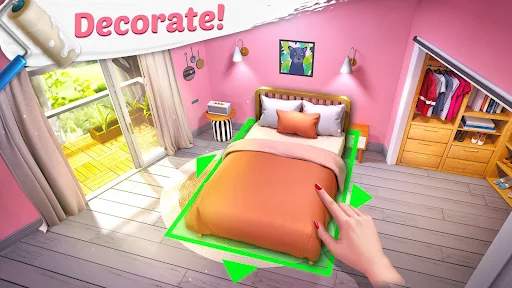
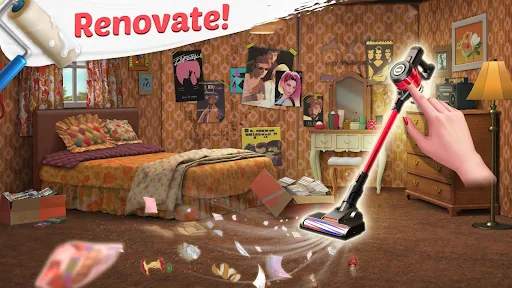
Project Makeover is a fun simulation game with great healing effect. This game integrates match‑three puzzle solving with character dressing and home renovation. The French sculptor Rodin once said, "Beauty is everywhere. It is not that we lack beauty, but that we lack the eyes of discovering beauty." After playing this game for over a hundred hours, you will gain a completely new understanding of this statement. Many times, beauty is not "discovered" by you. Instead, it is awakened by you, bit by bit, through patience and intuition. You do not play the role of a stylist, nor do you play the role of a renovator. You act as a midwife of beauty. You must earn stars and coins by playing round after round of match‑three puzzles, helping the characters in the game who have been crushed by life, restoring the beauty that was always there, hidden under layers of dust. The first character you help is Elena. She is an office worker who wears dark sweatshirts every day and ties her hair in a messy knot. Her story begins with you entering her home, which is chaotic like a windstorm just passed through. You help her clean the room, replace the sofa with a new one, and hang warm‑colored curtains. Then she stands in front of the fitting mirror. You pick out a crisp white shirt dress for her, paired with a delicate chain necklace. When she turns around from the mirror, gently smoothing the hem of her dress, a smile appears on her face, a smile you have never seen before, one that is relaxed and at ease. You will find that your own lips curl upward as well.
It is so satisfying to help people bring out their inner beauty. This satisfaction is not a sense of moral superiority that comes from thinking "I did a good thing". Instead, it is the feeling of witnessing someone finally choose to be gentle with themselves. She does not become a different person. She finally dares to be herself. This authentic emotional feedback keeps you going, even after failing and restarting multiple match‑three puzzles. What is more fascinating is the fact that when the characters in the game become beautiful, you feel as though you have become more beautiful too. This is not superstition. It is a psychological trap carefully set by the design. Every time you finish a character's hairstyle and makeup, the screen freezes on a close‑up shot, and the background music becomes softer, as though someone is whispering to you, "See? You can be this good too". When you put down your phone and go to wash your face, you find yourself evaluating your own wardrobe using the color‑matching logic you practiced in the game. That ocher yellow sweater you never wore suddenly has a reason to be put on again. The game quietly changes the way you tolerate your own appearance.
For this reason, if you are a person with a lot of patience, a special taste for beauty, and a strong intuition, this game is especially suitable for you. Most match‑three games on the market chase after a quick dose of excitement, giving you a bomb or a rainbow ball within ten seconds so you never feel bored. Project Makeover, in contrast, designs its levels like a soup that simmers slowly. To complete a single cake, you need to keep matching, collecting crystals of a certain color, and pressing forward. A single level can block you for half an hour. If you have a short temper, you might throw your phone. But if you enjoy taking your time, slowly searching for the most comfortable path of elimination, you will discover that this slowness is actually a different kind of aesthetic training. You have to look at the overall color distribution like you are blending a highlight, and then decide where to cut left or right, or when to trigger a rainbow ball. And when it comes to dressing up, you can use your intuition. The game does not force you to follow a fashion rule like "yellow skin should not be matched with the color purple". You are free to experiment. You can paint bright pink lipstick on a dark‑skinned character. In this world, you feel that you are not just randomly applying colors or spending coins randomly. Instead, you feel that you are creating a miracle, and you experience a satisfaction you have never felt before. Resources in the game are scarce. A complete "red carpet look" requires one hundred and twenty stars. After finishing an entire chapter with great effort, you may only earn one hundred and fifty stars. You have to make choices. You may give up the diamond‑studded high heels, and with the stars you save, you buy a lipstick that can lift the overall aura of the look. You do not buy the most expensive celebrity‑designer evening gown. Instead, you pick a classic little black dress with a clean cut, and with the money you save, you give the character a short hairstyle that makes her face look slimmer.
Just when you think you might have ruined everything, the final look is completed. The character spins around in a spotlight, petals fall slowly from the background effects, and every detail echoes each other seamlessly. You gasp. It is not just "Oh, that looks nice!" It is "I made this with a limited budget, using my own feeling. How is this even possible?" This satisfaction of creating a miracle is not like the feeling of a wealthy person buying everything without thinking. It is like the feeling of a craftsman who has made a unique, beautiful chair with his own hands, a solid, grounded pride. You have used your own judgment to change a life inside the virtual world. That sense of achievement stays with you as you return to the real world. It gives you a little more confidence when you decide what to wear the next day. Finally, this is a game to play with heart, not logic. What does playing with logic look like? You read guides first. You calculate the cost efficiency. You figure out which hairstyle gives the best value, which piece of furniture will bring you extra points. Then you go through each level mechanically, like doing a math problem. What does playing with heart look like? You laugh at a bubble effect during a match‑three puzzle even though you do not care about the score. Your eyes get wet over a small detail in a character's story. You spend ten minutes in the fitting room trying three different lip colors, just to see which one makes her eyes look softer.
You realize that when you let go of the calculation "I must be perfect", the levels actually go more smoothly, because your hands understand where to tap better than your brain does. The characters in this game, each of them has their own fears and desires. Helping them become beautiful is a healing journey that starts from the inside. You can only create truly moving looks if you empathize with their situations. This game does not test your IQ or your finger speed. It tests whether you have a soft heart that is willing to listen to beauty and feel it. Many players, when they first start playing Project Makeover, treat it as a casual time‑waster. They rush through a few hundred levels and then delete it. But if you are willing to slow down, to pause, even to go back and create a look for a character not because you need to pass a level, but simply because you think she deserves it, you will discover that this game is actually a gentle form of self‑education. It teaches you that beauty does not require anyone's permission. Your own intuition is the best guide for aesthetics, and patience itself is a power that can create miracles. At last, Project Makeover tells you that you are not limited to discovering beauty. You can also lift it out of the dust with your own hands. When you see those characters regain their light and say "thank you!" to you, you will understand that the person you were really helping was not them. It was yourself!