Editor's Review:
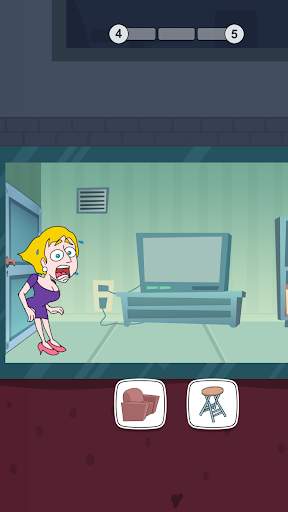
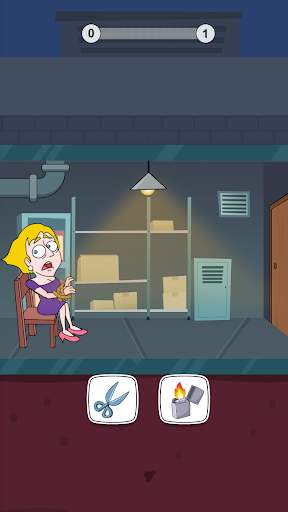
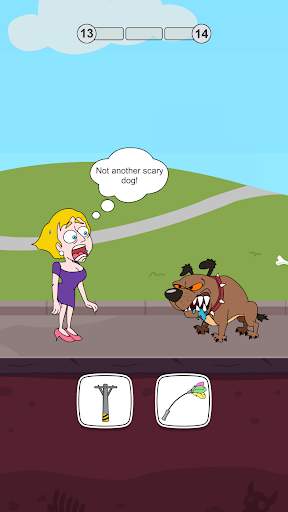
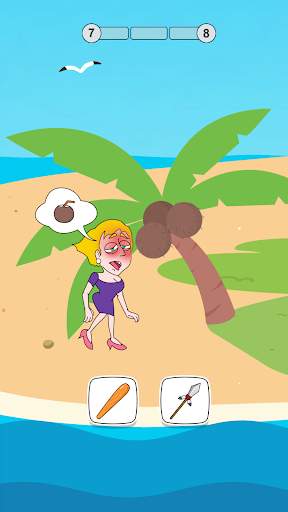
Save The Girl is a casual and relaxing puzzle game. At first glance, the game looks like the kind of "brain teaser". And you can almost imagine its general structure before actually playing: the girl is in danger, the system gives two or more options, and if you choose correctly, you continue; if you choose wrong, you trigger an exaggerated and somewhat spoof-like failure animation. But if you think of it only as a simple puzzle game, you are underestimating it. What really makes it captivating is not the depth of the puzzles, but its ability to compress the act of making a decision into a very short, fast, and addictive feedback loop. The typical experience is that it compresses all the parts of traditional puzzle games that involve searching, piecing together clues, and testing mechanisms into one instant judgment: there is danger in front of you, how will you save her? The key design trick is that it removes almost all of the exhausting parts of puzzle-solving, leaving only the most exciting neural response between judgment and result. The moment you click, you are not carefully reasoning, but making a mixed judgment based on intuition, common sense, absurdity, and a bit of gaming experience. The smartest aspect of Save The Girl is that it does not always reward realistic logic, and often deliberately breaks common sense, offering misleading choices that remind you this is not about strict reasoning but about game logic.
It does not ask you to think like you are solving a math problem, but to stay curious between ease and surprise. This is why the game has a strong sense of rhythm. There is almost no buildup. Each level quickly presents a small crisis and immediately gives you a choice. Kidnappings, traps, survival scenarios, and sudden dangers keep switching, and although each level is not complex, together they create a smooth progression. The introduction also mentions that levels are built around different dangerous situations, and some versions include two or three consecutive choices within one level. This means the fun is not about how difficult a single question is, but about what will happen next. It reflects a very modern mobile game approach: not focusing on depth within each level, but pushing players forward with frequent, fresh, and quick bursts of excitement. You may not be impressed by any single level, but it is easy to keep playing with the mindset of stopping after just one more level. What is most worth discussing about Save The Girl is its subtle sense of absurdity. Many similar games try to highlight consistent puzzles, logical traps, and well-rounded stories, but this game does not. Instead, it only gives you a chance to enjoy the fun interactive challenges. You may think you will open a door with a key, but the game makes you use a seemingly more complex prop; you may assume the safest, most conventional method, but it leads to failure in an unexpected way.
Of course, such a design also has its drawback, which is that its depth ceiling is not very high. After playing for a while, you will clearly feel that its core loop is quite fixed: encounter a situation, choose between options, succeed or fail, and move on to the next level. The game can keep changing scenes, but the underlying emotional rhythm remains almost the same. You may find it easy and fun in the early stages, but in the middle and later stages, you will start to realize that its novelty depends more on thematic variation than on the evolution of its mechanics. In terms of aesthetics and presentation, the character design is straightforward, the dangers are exaggerated, and the failure animations carry a touch of dark humor, but overall it does not take a heavy tone. Although the theme involves saving lives and escaping danger, it is not emotionally tense; instead, it uses a cartoon-like style that deliberately reduces the sense of danger. It does not try to immerse you in real fear, but rather to give you a light sense of entertainment between "something almost happened" and "how could it fail like this?" On the surface it looks like a rescue scenario, but in essence it is more like a small interactive comedy built on unexpected twists. This lack of seriousness makes it very suitable for fragmented time. You do not need to remember a storyline, understand complex systems, or stay engaged for long periods. You can start and stop whenever you like. From a deeper perspective, Save The Girl feels like a highly compressed "risk simulation." It simplifies complex real-life decisions into a few seemingly absurd choices, allowing you to experience the consequences of decision-making in a very short time.
Although the outcomes are mostly exaggerated and humorous, they still provide clear psychological feedback: your first instinct in dangerous situations is often unreliable; being clever does not always mean choosing the most obvious option, but choosing what fits the game's logic; and often we do not fail because problems are difficult, but because of our own quick conclusions. This gives the game a slightly teasing tone toward our habits of judgment beneath its light surface. It is not deep enough to become a serious allegory, but it still creates a subtle sense of self-reflection during trial and error: why do I always feel this answer is correct? Why am I so easily misled by appearances? In summary, Save The Girl is a game that clearly understands what it wants to do and what it does not. It does not aim for overly rich content, nor does it pretend to be profound. It does not try to become a complex puzzle masterpiece, but instead focuses on refining the simple pleasure of making a choice and getting immediate feedback.
This mini-game can also bring some inspiration to real life. In reality, you may be too used to setting up a kind of "self-censorship process" before taking action. Before doing anything, you tend to ask yourself first: does this make sense? Is this choice reasonable? Is it worth investing time in? Is my judgment logical? You have been trained to explain yourself clearly and to measure every action by purpose, efficiency, and outcome. Over time, it is not that you stop acting, but that you are held back by the order in your mind before you act. You always want to understand the reason, confirm that everything has a stable cause-and-effect chain, and make sure your choices are not absurd, impulsive, or meaningless. The problem is that sometimes your mind is drained by this excessive need for clarity. Life itself does not always make sense, and many things do not provide a perfect explanation before you act. This is what makes Save The Girl interesting. This experience is quite special, because it quietly reminds you that not every world needs to be understood by the same standards. In real life, you try to control variables, confirm meaning, and maintain logic, but in this game, you learn to set aside the habit of always asking why first, and instead accept a lighter, more flexible, and sometimes absurd way of thinking. That is why the fun of Save The Girl is not just about successfully saving someone. What makes it engaging is that it gives you a rare kind of mental permission to embrace absurdity. In real life, absurdity often creates discomfort, because it suggests loss of control and breaks your usual way of judging things. But in this world, things are totally different. You will find that not following conventional logic can also bring a unique kind of satisfaction. This kind of interaction offers a brief escape from the tension of reality.
If you think a little deeper, it even carries a subtle philosophical meaning. You know that in the end, none of us can leave this world alive, and no one can truly choose the final outcome. Because of this, many things can feel almost unsolvable if you think too far ahead. If the ending is inevitable, what is the point of everything now? The reason we keep living, acting, helping others, making choices, and moving forward is not because we have all the answers, but because the process itself brings real feelings. Save The Girl presents this idea in a simple and intuitive way. You know it is just a game, that the levels are absurd and almost childlike, and that it will not change reality, but you still feel a clear sense of achievement when you help the girl out of danger. That feeling does not come from discovering some ultimate truth, but from the simple experience that, at this moment, you accomplished something, moved forward, and briefly brought order to chaos. Therefore, seeing Save The Girl as just a simple puzzle game is a bit of a pity. On the surface, it asks you to make choices, but in reality, it offers a very different mental rhythm from real life. In reality, you tend to question whether your actions are reasonable, whether the consequences are controllable, and whether the meaning is valid. In this game, however, you learn to accept the unreasonable, the uncontrollable, and the idea that the world can sometimes operate in an absurd way. Strangely, once you truly accept this, you do not become more confused. Instead, you gain a rare sense of ease. You no longer need to explain everything clearly, nor carry the heavy consequences of reality at every step. You only need to make a choice within the absurd situation in front of you, and then watch the girl escape successfully. This sense of achievement may be the simplest and most valuable meaning in an otherwise absurd world!