Editor's Review:
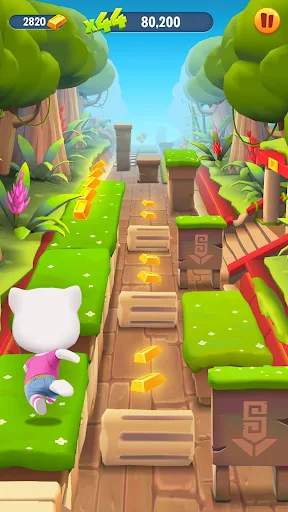
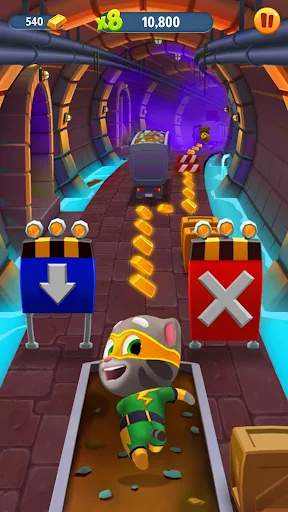
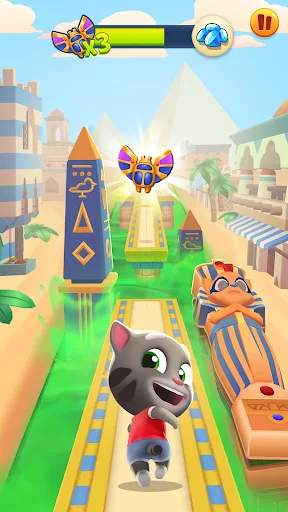
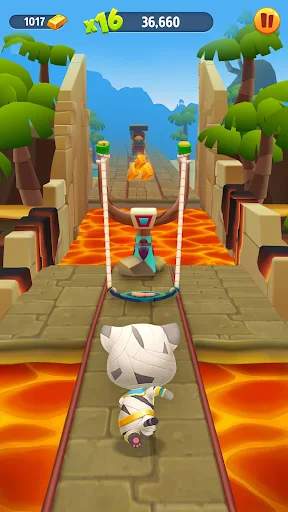
Talking Tom Gold Run is a parkour game based on route judgment, resource collection, and long-term character progression. On the surface, it is a fun endless runner about chasing a raccoon and racing forward, but underneath that surface, it is also a very carefully designed training ground for risk judgment. The pleasure of many parkour games is based mainly on whether the player is fast enough in reaction, but what makes Talking Tom Gold Run more interesting is that it constantly pushes the player to face another question, "When you are already running smoothly? When the coins ahead are densely arranged? When the route becomes more complicated?" This is where it truly separates itself from many games of the same type. It does not create excitement only through speed. It creates excitement through repeated temptation, exposing your rhythm, your desire, and your personality within only a few seconds. From the perspective of fundamental design, the rules of Talking Tom Gold Run are not difficult to understand. Lane switching, jumping, sliding, avoiding obstacles, collecting coins, chasing the raccoon who stole the gold, and then using that gold to rebuild the home and strengthen the cast create a cycle that is direct, clear, and fast in feedback. Familiar characters such as Tom, Angela, Hank, Ginger, and Ben also give the game a strong sense of identity and friendliness. It does not involve complicated gameplay. Instead, it uses intuitive controls to pull you immediately into the rhythm of running. Different environments, transition rhythms, vehicle segments, aerial platforms, train obstacles, coin placement, and multiplier growth together create a very mature structure in which greater skill naturally produces the desire to challenge yourself.
After playing for a long time, you will find that the most valuable thing to discuss about this game is not simply how fast it moves, but how it turns the pursuit of perfection into something both tempting and dangerous. You naturally want to do everything as well as possible. You want to take the full route, make no mistakes, miss no reward, complete event goals in one run, and maintain a high standard over multiple rounds. This urge to aspire to perfection is actively designed into the game. Through shining lines of coins, through platforms that look just reachable, and through rewards that seem as though they will disappear if you hesitate for half a second, it keeps encouraging you to move closer to a more perfect performance. Yet it does not truly reward rigid perfectionism. On the contrary, it almost tells you directly that you do not need to be perfect, you only need to be brave. Many decisions are not questions of technical skill. They are questions of whether you dare to take the gamble. Sometimes, the coin arrangement on a high platform looks so beautiful that you know one small mistake in timing will send you into a wall, yet your hand still moves upward. Sometimes, you see a more rewarding route hidden between two trains and understand that the risk is greater than the reward, but you still want to try. This is not a decorative interpretation imposed from outside. It is a real impulse that the game awakens during almost every run.
For that reason, Talking Tom Gold Run is more ambitious than many players assume. The ambition of this game does not lie in complex narrative or an enormous world setting. It lies in the way it turns a seemingly light form of play into a loop that can keep raising its own stakes. You do not feel satisfied with simply clearing a stage because there is no traditional ending here. What you pursue is a higher score, smoother control, more complete collection, more efficient conversion of resources, and one run after another that feels closer to the ideal. It understands very well how to create new desire inside familiarity. You may think you only want to pass a few minutes, but you will stay because you tell yourself that in the next run you will finally handle that difficult stretch of high platforms properly. It does not keep players through heavy content. It keeps them through a state of action that is repeatedly refreshed and repeatedly ignited. When you enter this game, your energy rises immediately, as if you have been recharged. It has a rare ability. It does not pull you into passivity. It makes you move at once.
This connects to a striking contrast in experience. In real life, you often prefer safety, reserve, and control. You are afraid of mistakes, embarrassment, and wasted effort. But in the world of Talking Tom Gold Run, you actively want to jump down from a high platform, enter a tighter gap, and test routes that clearly do not look safe. The reason is simple. This game transforms risk from something that feels like disaster into something that feels like fun. Failure certainly arrives, and it arrives often. Sometimes, you will be in the middle of an excellent high scoring run and then crash into the simplest barrier because of one small error. That moment can feel a little embarrassing. In a certain sense, there really are humiliating moments, especially when you are already close to your goal and already convinced that this round is yours. Yet strangely, you do not feel only frustration. You feel excitement almost immediately after the disappointment because you know that the run was very close to ideal. Failing so near to success proves that the next attempt might really get there. Those runs in which you almost reach the target are often far more addictive than those in which you survive for a long time without anything memorable happening. This is also why the game becomes most interesting when viewed from a fresh angle. It does not merely test reaction speed. It allows you to observe how you approach challenges. Are you the kind of player who becomes conservative once the score rises? Or the kind of player who cannot resist taking a chance when a beautiful line of coins appears in the distance? When the same type of obstacle keeps defeating you, do you become irritated immediately, or do you begin to study the pattern after repeated failures? Do you seek only reliable income? Or are you willing to accept uncertainty in exchange for a more efficient route? These questions sound psychological, yet Talking Tom Gold Run compresses them into a very short action loop that can be examined again and again.
Every run becomes a small mirror. It is not a large one, but it is honest. You discover that you keep losing in the same place not because the game is being unfair, but because you keep making the same mistake in the same rhythm. You discover that once the score becomes high, your hands become tense and your movements become stiff. You also discover that once you accept the fact that no run will ever be completely flawless, your body relaxes, your judgment becomes more precise, and your performance improves. That strange experience in which you perform better after becoming comfortable with imperfection is not empty encouragement here. It is something you can feel directly in your hands. Michael Jordan once said that, "I have failed over and over and over again in my life. And that is why I succeed". This sentence suits Talking Tom Gold Run not because it sounds dramatic, but because the game truly turns trial and error into one of its central pleasures. You will go through constant experimentation. You learn when to jump early before a moving platform, when to protect your lane before changing direction, when the coins above are actually a trap, when a slide should be followed immediately by horizontal movement, when the profit of a magnet or helmet should be maximized, and when you should abandon a visible line of coins in order to preserve the rhythm of the whole run. None of these things can be fully explained by a tutorial. They can only become instinct through repeated attempts, failure, and adjustment. The design is clever because it never lets experimentation feel too painful. The cost of restarting after failure is low, and the rhythm returns very quickly, so you always feel willing to run again. Once that desire for one more attempt is maintained, perseverance itself becomes part of the pleasure.
For that reason, this game truly requires perseverance. Even though the basic controls are easy to learn, anyone who wants to produce beautiful scores, combine running rhythm with long term progression, maximize the value of events, and push the cast and the environment further will need patience and endurance. This becomes especially clear when the same type of terrain defeats you again and again. You realize that you are not incapable of playing well. You simply have not fully crossed that threshold yet. That feeling of meeting the same problem again and insisting that this time you will solve it creates a very deep form of engagement. You may even refuse to defer that one final sprint toward the destination. Even when you are already tired after the last attempt, and even when reason tells you that you can stop for now, your fingers still want to continue because you do not want to postpone that nearly successful run until tomorrow. You want to try again right now. You want to rush out immediately. You want to repair that section of the route that you handled badly.
The emotional design of the game also deserves attention. Unlike many endless runners, Tom is not merely a skin under control. His overall presence always carries a light and cheerful sense of encouragement. When you fail, you do not feel that the system is humiliating you. When you succeed, the reward does not become so heavy that it feels purely meaningless or fake. The experience instead feels as though Tom is always running ahead with you, reminding you to try again after a mistake and continue after a good run. This sense that Tom will always cheer you on matters a great deal over the long term. You do not enter this world because you fear punishment. You return to this world because this world can quickly pull your mind out of dullness and back into excitement. So Talking Tom Gold Run compresses ambition, courage, failure, repeated attempts, the excitement of collapsing near the goal, and the stubborn refusal to surrender into runs that may last only a few minutes or even a few dozen seconds. Sometimes, it may seem that there is no way for you to win. The obstacles ahead become denser; your hands start to shake; and the higher score only increases the pressure. Yet those are exactly the moments in which you should never give up. The game keeps proving one thing. You do not run farther because you are perfect. You run farther because you refuse to stop. You can take risks; you can make mistakes; you can crash into an obstacle at your most awkward moment; and you can fail when you are only one step from the target. But as long as you are willing to continue, genuine judgment will slowly grow out of those incomplete runs. At last, what makes the experience addictive is not perfect completion itself, but the feeling that even after many failures, you still want to rush toward what is ahead one more time. For a parkour game, that is already far more meaningful than simple entertainment!