Editor's Review:
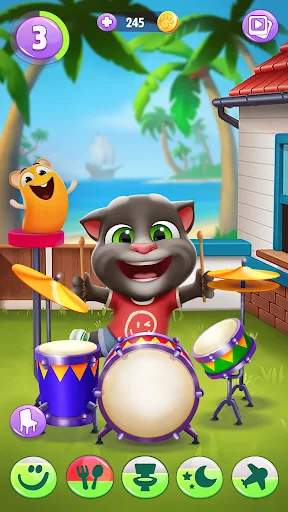
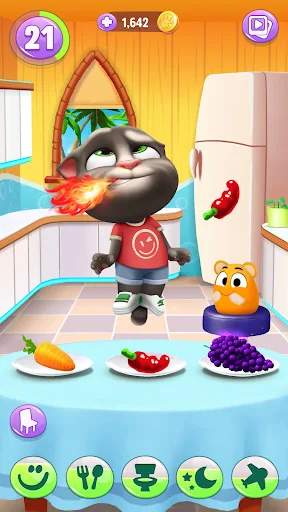
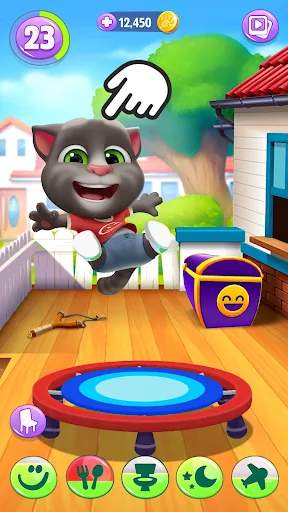
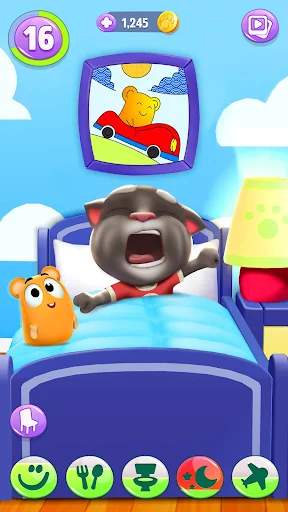
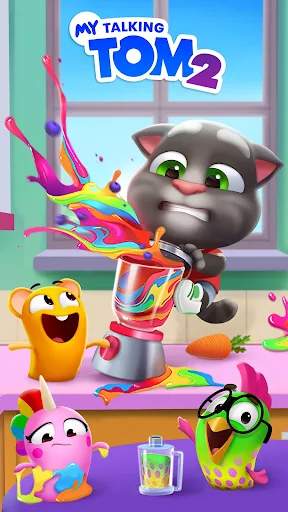
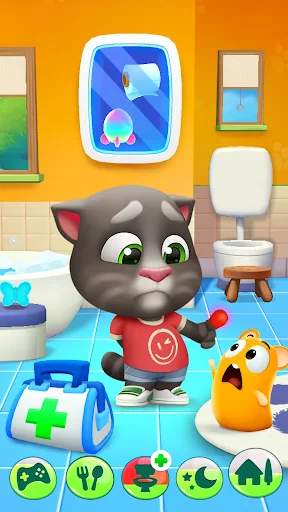
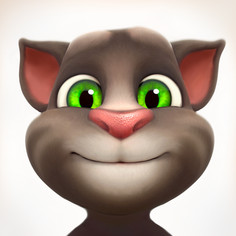
My Talking Tom 2 is a casual mobile game of virtual pet raising, combined with interactive simulation and mini game challenges. In this world, Tom is no longer just a static object waiting for you to log in and clear his need bars. He feels more like a virtual partner who creates rhythm, interrupts your routine, gives you feedback, and pushes you to form personal preferences. You are not mechanically completing tasks. You are constantly taking part in a daily relationship system that looks light on the surface but actually understands human habits and preferences very well. The basic gameplay of My Talking Tom 2 is clear and straightforward. You take care of Tom by managing food, sleep, hygiene, and mood. You can also earn resources through mini games, change his outfits, decorate his surroundings, collect pets, and sustain a daily rhythm that is constantly refreshed and constantly satisfied. Compared with the first version, the feedback is denser, activities are more varied, interactions are livelier, and transitions between different layers of content are smoother. Tom does not simply respond to what you say. He feels as though he keeps pulling you back into this world through all kinds of small events. You begin to realize that you are not merely raising him. You are living alongside a cute character who is expressive, energetic, and constantly reinforcing his own presence.
Because of this, the most valuable new angle of this game is not how many mini games it contains, but how it deals with the idea of being shaped by the outside world. From the moment you enter this human world, opinions of other people are constantly pushed into your mind. Parents tell you what kind of person you should become. Society tells you what success is supposed to look like. People around you keep handing you templates for being proper, cute, pleasing, and acceptable. At first sight, My Talking Tom 2 is obviously not delivering these ideas in a direct way. Yet the structure of play reflects this condition with surprising precision. Tom responds to you, grows according to the rules of system, and is surrounded by outfits, decoration, pets, and mini games, like a character who is always being defined by something outside himself. The real question is whether the player outside the screen is creating, or simply consuming according to a template. Ralph Waldo Emerson once said that, "Trust yourself! Create the kind of self that you will be happy to live with all your life". This line fits My Talking Tom 2 very well, because the real value of this game is not that it offers one standard answer. It keeps giving you chances to test what kind of Tom, what kind of rhythm, what kind of visual taste, and what kind of companionship actually feels right.
Many players fall into a familiar mistake when they play this type of game. They turn themselves into executors of an optimal solution. They constantly ask, "Which setup is most efficient? Which mini game earns the most currency? Which growth path saves the most time? Which decoration style looks most like the finished examples shown by others?" From the perspective of efficiency, this way of thinking is understandable. From the perspective of experience, however, it quickly hollows out the most valuable thing in a virtual pet game, which is the personal and genuine bond that could have existed between the player and the character. Little by little, you no longer like the version of self that you have shaped through play. You are only performing a role pushed along by system. Tom becomes a character, and you also become a character. This is exactly where My Talking Tom 2 is smarter than many games of the same kind. Even though it still has strong reward loops and clear content incentives, it leaves enough space for players to like the version that they themselves create, instead of forcing them into a form already defined by others. You can dress Tom in a cute way, or in an exaggerated way. You can make his room lively and colorful, or clean and orderly. You can focus on progression through mini games, or enjoy care and interaction for their own sake. These small choices may seem trivial, but together they keep reminding you of the same questions, "What do you actually like? What kind of self do you actually want to move toward?" This process is not completed through thought alone. It is discovered through experimentation.
A person does not usually find self simply by sitting still and thinking about who that self is. More often, self is gradually discovered through repeated experiments, through learning what genuinely excites you, what makes you feel alive, and what is merely a prefabricated standard handed to you by other people. One of the strengths of My Talking Tom 2 is that it makes experimentation feel easy and free of pressure. Today, you can try a new style of outfit. Tomorrow, you can change the rhythm of interaction. The day after that, you may suddenly become attached to a certain mini game or a certain style of room design. There is no heavy punishment here, and there is no irreversible failure. Because of that, it becomes easier to let go of the habit of overthinking, of always wanting the perfect choice, and of fearing that one wrong move will ruin everything. Much of the real sense of relief that players gain from this kind of game does not come from childish simplicity. It comes from finally being allowed to act first, try first, and feel first, before deciding whether something truly belongs to them. From the standpoint of design, the greatest strength of My Talking Tom 2 is the intelligence of feedback. Expressions, movements, and voice reactions of Tom become more vivid than before. More importantly, this is not humor for the sake of empty humor. It continuously reinforces the feeling that whatever you do is actually received by him. Tom makes you feel that your attention is not wasted. Even something as small as feeding Tom once, patting him on the head, or changing one outfit can feel acknowledged.
You will also like the sense of pets and exploration, because which makes the world of Tom feel less like a closed room and more like a personal space that can expand and grow. These features do not exist to make the game artificially complicated. You are not repeating care inside a static container. You are gradually building a small universe of your own. This change is very important, because it makes cuteness something more than a surface style. It becomes an atmosphere that can be shaped and maintained. Cuteness is no longer the appearance you are told to perform. It becomes a feeling that you genuinely choose through trial and error and want to live with over time. Besides, this game quietly reminds you not to live like a puppet. Inside this virtual world, Tom is naturally a highly reactive character. He eats when hungry, sleeps when tired, laughs when entertained, and shouts when stimulated. There is nothing wrong with that, because he is a virtual character built by design. You, as the player, however, should not turn yourself into the same kind of being. A major problem in real life for many people is that they are too ready to please others, too ready to accept identity labels given from outside, and too ready to hesitate among countless opinions until they become background figures waiting for instructions. My Talking Tom 2 can actually make you realize in a very relaxed environment that what makes a person proud is not becoming a shadow and shape that satisfies everybody else. It is finally beginning to like the version of self that has been tested and discovered through personal choice.
Anyway, this game helps you understand how to gain a gradually clearer sense of self through interactions of extremely low threshold. You do not remain here in order to become a more perfect player in the eyes of other people. You play and have fun in this world because, through all these repeated small experiments, you slowly learn what you actually like, what you are willing to invest in, and what you want to keep in life. In this version, Tom has become noisier and more active. But in the meantime, Tom, serves as a mirror, teaches you to move away from false identity. You can burn away those fake masks you wear for the sake of pleasing others, matching a template, or performing correctness. What remains in the end is not some perfectly standardized raising result. What remains is your true rhythm, your true aesthetic preference, and those moments that genuinely make you feel alive. For a virtual pet-raising simulation game, that already goes beyond being merely suitable for passing time. It is worth playing because, beneath the cuteness and ease, it really gives you a rare chance to move closer to your true self not through empty thought, but through trying things out!