Editor's Review:
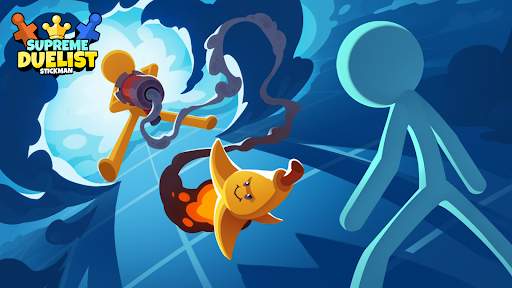
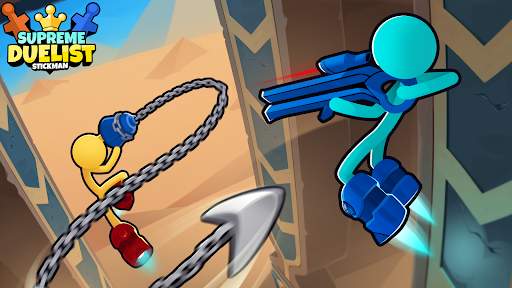
Supreme Duelist is a side scrolling action fighting game focused on physics based combat. You will notice that the highlight of this game is not simply how flashy the fights can be, but how it removes "violence" from the ethical consequences of real life and compresses it into a pure interactive system. You swing weapons, test distance, predict movement, search for openings, and finish reversals. The whole process is no longer about real injury, but about an experience of conflict that has been disciplined by rules. Heraclitus once said, "War is the father of all and king of all." This is, of course, not a justification of real violence, but within the context of Supreme Duelist, it explains the core pleasure of the game with surprising accuracy. Conflict itself is the source of gameplay, rhythm, drama, and emotional release. When you first enter this game, you may notice that the presentation of Supreme Duelist looks very simple: stick figure characters, lightweight visuals, intuitive controls, and an appearance that may even suggest something casual. But once you invest enough time, it becomes clear that this is not a small game surviving only on exaggerated physics effects. It is a game with very high demands in the area of situational judgment. Many players first focus on the number of weapons, the stage hazards, and the comic quality of the character movement. Yet the longer one plays, the more obvious it becomes that what truly makes this game work is a combat structure built on the edge of chaos. You can never output damage with complete certainty. You are always searching for the most effective line of attack within wobbling movement, rebounds, terrain changes, and enemy actions. This is not the kind of fighting game in which memorizing a sequence of inputs guarantees victory. It is much closer to a dynamic duel of interpretation and response.
It satisfies humanity's ancient fascination with controllable violence. Violence has almost never disappeared from human history. It feels like something buried in instinct, in competitiveness, and in the memory of survival itself. In real life, most people do not have the chance, and would not truly want, to enter a bloody and dangerous duel burdened with pain and moral consequences. The brilliance of game design lies in offering a safe substitute. In this world, you can become fierce. You can pick up weapons that create massive destruction. You can push conflict to an extreme in order to survive. Yet you do not bear the physical cost of real life, nor do you sink into the moral concerns of truly hurting another person. The game transforms danger, aggression, and survival pressure into an experiment that can be repeated, paused, and left behind. Many people describe this only as "release," but it is more than that. It is a structured outlet for emotion. What deserves serious praise is that the emotional release of this game does not feel cheap. Many games offer a sense of release, but only through mindless domination. Supreme Duelist does not work that way. The release of emotion depends on the fact that the confrontation is real within the logic of the system. You are not pressing a button just to watch a visual effect. You must step into danger yourself. You must take responsibility for the cost of bad judgment. You must recover your rhythm in the middle of chaos. When you are pushed into a corner, launched into the air, or trapped under pressure, you must find a way to turn the match around. Because victory is not handed to you cheaply, the emotional release of victory becomes more effective. The feeling of a last second reversal, a desperate counterattack at the edge of defeat, or a survival driven comeback is not an empty thrill. It becomes a precise psychological compensation, that is, "I was pushed to the limit, but I took control again". That is the sense of empowerment at the center of the experience. It is not power granted by the system. It is power earned under pressure.
From the perspective of action design, it seriously treats the reading of an opponent's movement. In many noisy light fighting games, confrontation is ultimately little more than a race of numbers and reaction speed. Observation and prediction are not truly essential. That is not the case in this game. Because the instability of physics simulation is so strong, every approach, jump, retreat, pause, roll, and weapon angle of the opponent can change the result of the next second. If you attack blindly, you will often be punished. If you only retreat, terrain will corner you and kill you. Over time, what separates strong players from weak ones is not merely speed of input, but the ability to read motion. You need to figure out questions like "Why did the opponent stop just now? Is that hesitation a trap to make me commit first? Where is the true effective range of this weapon? The opponent is leaning off balance at this moment, so should I rush forward or circle behind?" These judgments do not come from theoretical terminology. They come from the bodily intuition formed through many matches. For that reason, Supreme Duelist can occasionally produce a very special kind of peak experience. This experience is not constant. It appears in a brief instant during a match, when concentration suddenly becomes total. You see clearly what the opponent wants to do. The motion of your character connects perfectly with your prediction. The physical feedback of the stage does not interfere, but instead pushes the moment forward. Then you finish the exchange with an elegant final blow that feels almost instinctive. In that second, judgment, action, feedback, and result become one unbroken line. Consciousness narrows into an unusually clear passage. Great action games can all provide moments like this, but the special achievement of Supreme Duelist is that it reaches that height through extreme simplicity.
It allows you to enter the battle almost immediately, while still preserving a high ceiling. The threshold is low because the rules are direct, the visual information is clear, the cost of failure is small, and restarting is fast. The ceiling is high because if you want to win consistently, you must understand spatial awareness, weapon behavior, tempo control, terrain use, risk evaluation, and psychological pressure. This is intelligent design. It makes room both for casual players and for long-term players who continue to extract new understanding from small details. Gradually, it becomes clear that the maps are not merely background. They are part of the relationships of combat. Weapons are not just numbers of damage, but extensions of rhythm and threat range. Even the off balance wobble of the characters is not only comic. It is tactical information that must be corrected, exploited, and respected. The appeal of the weapons in Supreme Duelist does not come only from quantity or visual difference. It comes from the fact that each weapon represents a different method of applying force. Some weapons encourage direct pressure. Some are best for countering. Some pursue explosive impact. Others are more suited to spacing and attrition. What changes when you change weapons is not only the model in your hand, but a philosophy of combat. Heavy weapons make destruction feel tangible. Light weapons let you enjoy speed and sustained pressure. Ranged or unusual weapons shift the fight away from direct collision and toward the control of space. In this virtual world, you do not only want to win. You also want to win in a way that matches your temperament. You may prefer to crush the opponent head on, wait patiently for mistakes, or you may prefer extreme movement and then one fatal strike.
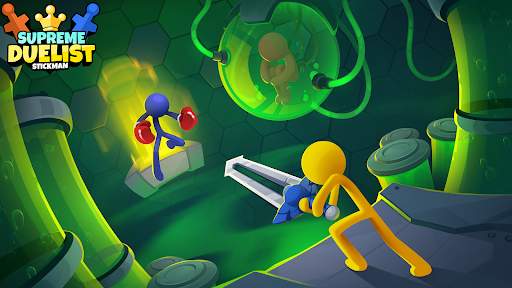
The design of the maps is equally worthy of praise. The stages look simple, but they constantly rewrite the logic of combat. Narrow areas magnify the value of close range pressure. Height differences change the risk of jumping and rushing. Hazards and obstacles make survival itself more important than raw output. This connects closely with the idea that in this world violence is not performed for spectacle, but for survival. You are not displaying technique in a sterile arena of perfect fairness. You are fighting to stay alive inside an environment that can reverse the situation at any moment. As a result, every match becomes not only a question of how to hit the opponent, but of how to live longer than the opponent inside a dangerous structure. That gives combat a natural tension. It also means that defeating the opponent is not only a numerical result, but a temporary domination of chaos. It can be enjoyed as a lively match between friends, as a tool of emotional decompression, or even as a way of observing one's own psychology under pressure. Under stress, are you impatient and aggressive, or calm and reactive? Do you like to seize initiative, or strike after the opponent commits first? Are you trying to produce the most efficient solution, or are you pursuing a move that simply feels beautiful and decisive? In real life, one rarely has the chance to engage in such intense and direct physical confrontation, and certainly not to swing exaggerated weapons without consequence while pouring frustration, pressure, competitive instinct, and aggression into the act. Supreme Duelist provides exactly that outlet. It transforms violence from harm against another person into a psychologically regulated form of adjustment, a way of gaining clarity, intensity, and a renewed sense of existence through confrontation!