Editor's Review:
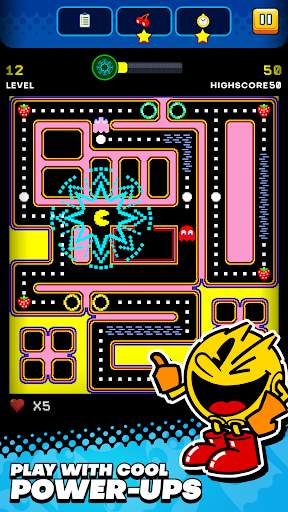
Pac-Man is often simply classified as a classic arcade or casual game, but this perception actually underestimates its profound value in terms of design and culture. In terms of gameplay, it builds a highly complex strategy system with extremely simple rules. It seems that players only need to eat pellets and dodge ghosts in a closed maze. But beneath the simple gameplay, you will find a multi-layered decision-making structure. The four ghosts do not move randomly; each has different movement patterns, making the rhythm difficult to control. So in order to eat more pellets in this maze, you not only need amazing reaction speed, but also a perfect understanding of the ghost's movement patterns. But after you gradually learn their patterns, your actions will no longer be passive in this maze. You can actively anticipate their next moves and make the right decisions to avoid potential dangers. At the same time, the "prey-hunter" identity reversal mechanism brought by the energy beans creates a rhythm cycle of tension and release. This emotional design is highly forward-looking and promising. On the spatial level, Pac-Man encourages players to plan paths and optimize efficiency through fixed mazes and limited paths, gradually shifting from random movement to precise calculation.
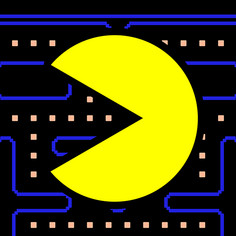
In terms of audio-visual presentation, Pac-Man embodies a highly restrained minimalist aesthetic. You will notice that characters, enemies, and maps are presented in the most basic geometric forms, but with extremely high recognizability. As you play, you will also feel a sense of familiarity toward the color-distinguished ghosts and the clearly structured blue maze. And this interactive system can be understood without the need for textual explanations; besides, the sound effects are not just decorations but are embedded as feedback mechanisms in the gameplay. When you are engaged in a battle of wits with the ghost in this maze, your mind will become increasingly clear, your attention will be highly concentrated, and your observational ability will also be continuously magnified, because you gradually realize that the ghosts do not act randomly but follows specific rules. At first, you may just instinctively run away, feeling tense and even confused in the constant pursuit, but as the game progresses, you start to actively observe their paths, rhythms, and turning habits, and build up a framework for understanding the patterns in your mind. In the process, your way of making decisions changes as well. Your behavior will shift from passive response to active anticipation, from temporary evasion to path planning. The gaming experience becomes significantly more engaging when you can predict the ghost's location in advance and take control of the situation by turning, circling, or even moving in the opposite direction. This change is essentially a cognitive upgrade, meaning that you are no longer just "playing the game" but "understanding the system."
And it is this process of moving from chaos to order and from the unknown to control that brings a strong sense of psychological satisfaction. You will clearly feel that every step you take is more purposeful, and every successful evasion or counterattack is no longer a matter of luck but the result of judgment and strategy. The sense of control that comes from a full understanding of the gameplay will constantly strengthen your desire to win and give you the urge to try again. So you will always choose to have another round, because that sense of achievement comes not only from the improvement in your score, but also from your mastery of the rules and confirmation of your own ability. At the same time, your psychological qualities will also be tested. Of course, you need to move quickly through the maze, but at the same time, you also need to stay calm, restrained, and clear-headed under constant stress. On the surface, it seems that your task is just to eat as many pellets as possible, but in reality, every step forward is accompanied by risk assessment. You cannot ignore the location and movement direction of the ghosts just because you are in a hurry to swallow the beans in front of you, since in Pac-Man, failure often does not start with a huge mistake, but with seemingly insignificant greed. Perhaps you just stayed for an extra second to eat a few more beans, or perhaps you just took a chance to brush past a ghost, but it is this momentary hesitation and rashness that often quickly puts you in a situation where you are cornered and end up in failure.
Therefore, what this game really tests is not just the speed of your hands, but whether you have overall strategic thinking. You cannot just focus on whether the path in front of you is safe. You must keep observing the changes in the maze as you move, and think about the next step, the step after that, and even further routes. When to enter a narrow passage, when to return to an open area, and when to turn early to avoid high-risk areas, all these judgments determine whether you can take control of the situation. Planning your route in advance is not just about improving your bean-eating efficiency, but also about leaving yourself a way out when danger comes. Because once you lack a sense of the big picture and focus only on the points at hand, you can easily be pushed step by step into a dead end by the ghosts and end up with no way out. More importantly, Pac-Man keeps reminding players that being at a disadvantage does not mean real failure. No matter how tense the situation is, no matter how close the ghost's pursuit is, you should not give up easily because the game always reserves the possibility of reversing the situation. The presence of the power pellets is the most direct manifestation of this design concept. One second you might be the fleeing prey, and the next you have the chance to reverse your role and regain the initiative. And that is why you must always remain hopeful and patient and not lose your composure just because your are temporarily suppressed.
Often, it is not the situation itself that really determines the outcome, but your mental state when facing it. So, while you are exploring the maze, your ability to keep calm is particularly important. Only by staying calm can you quickly determine the safest direction in a complex situation and still make rational choices when pressure approaches. If you blindly accelerate out of panic or make random turns in fear, what seems like a "desperate escape" is actually a kind of disruption of your own rhythm, causing a situation that is completely out of control. The more dangerous the situation, the more stable your mindset needs to be, and the clearer your judgment must be. It can be said that Pac-Man is not only a game that tests your strategic thinking, but also a training of your patience, willpower, and emotional control. It makes you understand that a true master is not someone who never gets into danger, but someone who, even when in danger, remains clear-headed and finds a chance to turn the tables step by step.