Editor's Review:
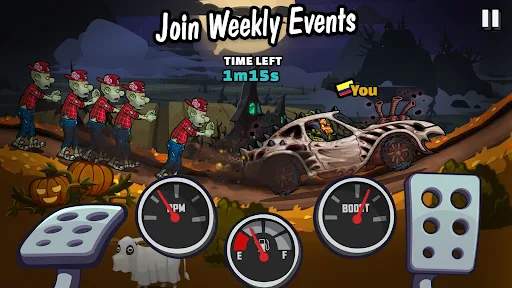
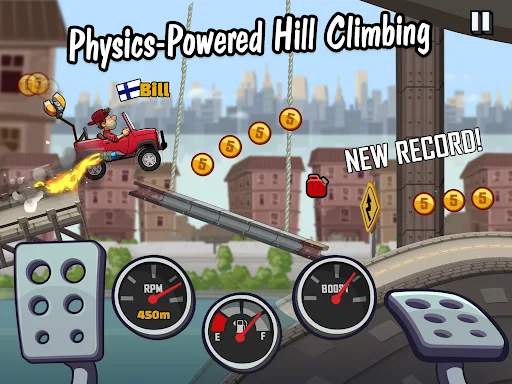
Hill Climb Racing 2 is a physics-based racing game. What makes it different from other similar racing games is not speed, but control. Many racing games are built around raw pace, racing lines, and reflexes. Hill Climb Racing 2, however, is fundamentally about your ability to read a vehicle's center of gravity, landing angle, throttle rhythm, and the rise and fall of the terrain. You are not simply rushing toward the finish line. Actually, you are learning, little by little, how to work with a vehicle that seems to have a mind of its own. When should you feather the throttle? When is it better to slow down a little just to keep the car balanced? These small decisions will bring you a great pleasure, and they are also why this game remains so compelling despite its seemingly simple structure. At first glance, Hill Climb Racing 2 does not look especially complex. Its art style is clean and straightforward, and the controls are almost minimal. It basically involves just two pedals from start to finish. But the moment you actually start playing, you realize that this simple design gives you immediate feedback. Every action of pressing a button is reflected immediately in the way the vehicle moves, especially on uneven slopes, chained jumps, awkward landings, and rough climbs. When the car loses balance, it rarely feels unfair. The game does not seem to be cheating you. More often than not, you know exactly what happened: you gave it too much gas a second too early, or you failed to straighten the vehicle before landing. That kind of failure does not usually feel frustrating. Instead, it makes you want to try again, because you know the mistake was yours, and you know you can fix it.
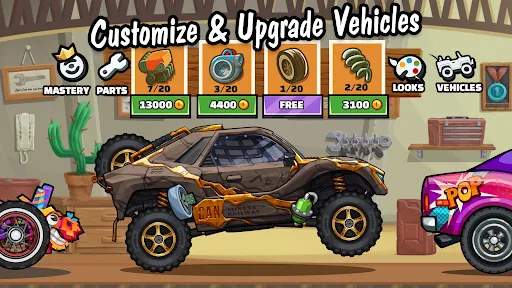
One of the smartest things about the design of levels and racing tracks is how well it turns repetition into variation. The slopes, bounce points, dips, and obstacles are not there merely to make things harder for you. They constantly reshape the way you understand the rhythm of each vehicle. Racing the same track with a different vehicle can feel surprisingly fresh. The strange thing is that the same racing track can feel like a completely different track. You can also customize the same car with a different setup, and then you will have a totally new car to try. Because of that, you will find that this racing game always gives you something new to try. The vehicle system is also unique. Different vehicles will change your racing experience. You will not simply feel that you just unlock a new vehicle with a different color. Each customization genuinely changes the way you play. You will notice that some vehicles are stable and dependable, ideal for applying a steady approach. Some vehicles are powerful and explosive, but much easier to tip forward or flip over. Some excel on rough off-road terrain, while others are better suited to holding top speed. This kind of variety means in this world you are not simply chasing a single "best car." Instead, you gradually start thinking in a more interesting way: which vehicle fits this track best? In other words, the game is not built solely on linear stat progression. There is real enjoyment in understanding the gameplay. Once you get deeper into it, your impressions of each vehicle become more specific and more tactile.
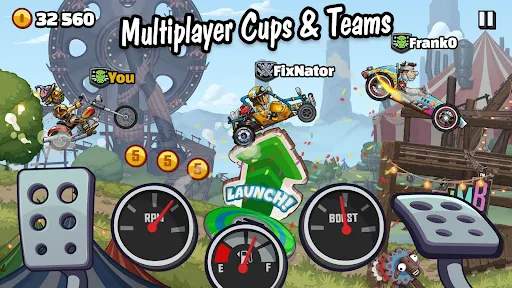
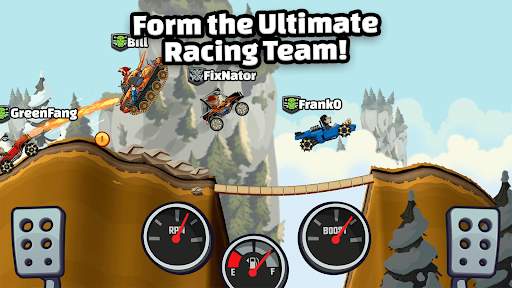
What the game does better than many others in the genre, though, is that it never lets numerical progression completely overshadow player skill. A stronger, better-upgraded vehicle can absolutely give you more room for error, but the real difference still comes from understanding the terrain and feeling the rhythm of the run. Skilled players can often produce beautifully "clean" runs even without outrageous stats: controlled takeoffs, smooth landings, efficient climbs, no wasted momentum. Watching that kind of run is satisfying in itself. It is one of the clearest reasons why Hill Climb Racing 2 can become so addictive. You can feel that you are not just increasing stats. You are actually learning how to drive. The multiplayer side of the game enhances that appeal even more. It is not a multiplayer racer built around chaotic collisions. It feels more like a test of who can execute more cleanly under pressure. Once your performance is measured against real players, every small mistake becomes more visible. A slightly over-tilted jump can cost half a second. A messy landing can throw off the rhythm of the entire run.
As for the visuals, the game is not spectacular in a flashy sense. The cartoon style is unique and clear, which matters a lot in a game where you need to judge the situations of different terrains quickly. The vehicle animations are exaggerated without becoming messy, and details like suspension compression, flips, and rebound help convey the car's behavior effectively. As for the sound, the sound design is similarly understated but effective. Engine noise, the impact of landing, and the hard thud of rough contact all give the vehicles a stronger sense of weight. In games like this, the greatest danger is that the handling might feel floaty. Hill Climb Racing 2 does a good job of avoiding that. Its audiovisual feedback makes the vehicles feel light and playful, but never weightless. From another angle, Hill Climb Racing 2 almost feels less like a traditional racing game. What you are reacting to is not simply a sequence of turns, but a chain of beats made up of slopes, jumps, airtime, nose control, landings, and acceleration. When a run goes well, it develops a very distinct rhythm: accelerate, ease off, bring the nose down, tap the gas again, land cleanly, and carry that momentum into the next section. It is not rhythm in the musical sense, but an internal rhythm born from terrain and vehicle response. That is one reason its appeal feels more intimate and tactile than that of many more visually extravagant racing games. What stays with you is not some giant cinematic moment, but the feeling of threading a whole uneven section perfectly, of keeping the vehicle under control from one motion to the next. That sensation is specific, physical, and deeply satisfying.
Of course, the game is not without flaws. First, because it follows the structure of a free-to-play mobile title, it can never remain completely pure. Chests, resources, quests, events, and progression systems gradually take up some of the mental space that would otherwise belong entirely to the driving. Second, while the game offers a lot of content, long-term play still revolves around variations on the same core mechanics. If you do not have a lasting interest in the feel of the physics itself, fatigue may eventually set in. And on top of that, some vehicles and balance decisions can create a fairly strong sense of winners and losers at different stages of progression. It is not so extreme that it breaks the game, but it can create an awkward tension between "the vehicle I enjoy" and "the vehicle that is clearly more efficient." Even so, Hill Climb Racing 2 is still the kind of racing game that players love. What it truly accomplishes is not scale, but refinement. It takes a very small mechanical foundation and polishes it until it feels remarkably solid. The game understands exactly what its core is. So even though it is wrapped in all the familiar structures of a modern mobile game, upgrades, events, rankings, daily systems, the underlying pleasure of physics, rhythm, and control remains intact. If you are willing to really pay attention to its handling, it stops feeling like a casual time-killer and starts feeling like a game where you can slowly develop touch, judgment, and even something close to real vehicle intuition.
Overall, what deserves the most praise in Hill Climb Racing 2 is not simply that it is easy to pick up, but that it still leaves plenty of room to master. It turns two buttons into something skillful. It gives cartoonish little vehicles a real sense of weight. It makes this short mobile racing game feel worth replaying and refining. That kind of design discipline is genuinely hard to achieve. So Hill Climb Racing 2 is not a game that wins you over through novelty, but through feel, through the quality of its handling, the responsiveness of its physics, and the quiet harmony of systems that have clearly been refined over time. It looks light, but it takes itself seriously. It feels casual, yet once you get into it, it becomes surprisingly exacting. So if you are a player who values driving feel and take pleasure in refining subtle details within a simple system, you should try this racing game and you will find that it stands as one of the strongest games in its niche!