Editor's Review:
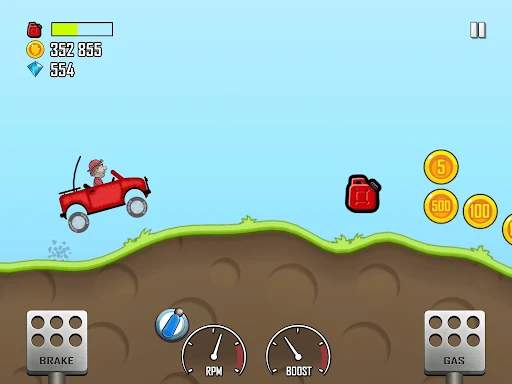
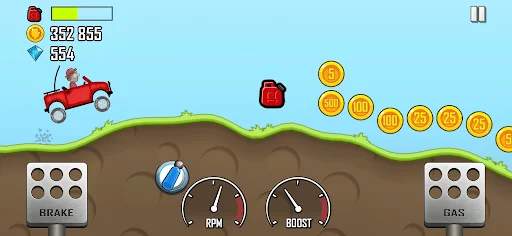
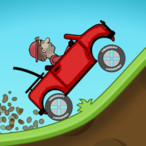
Hill Climb Racing is a casual driving game. What truly stands out about this game is not advanced visuals or complex content, but the way it creates a complete and highly enjoyable gameplay loop with an extremely low barrier to entry for enjoying the exciting driving experience. At first, you just want to enjoy the excitement of driving, but gradually, you find yourself studying the center of gravity of each vehicle, the slope of each track, when to tilt forward to save fuel, and when to lean back to avoid crashing. It sounds simple, but actually it is quite challenging. The controls in Hill Climb Racing are very simple. There are only two buttons: accelerator and brake. However, these buttons do much more than simply speeding up and slowing down. They are also the key to controlling the balance and movement of the vehicle. You can press the accelerator hard when going uphill. You can tap the brake to maintain the balance. When the vehicle is in the air, it is more important to adjust the angle because it would be too late when your vehicle lands on the ground. After playing for a while, you will realize that the game does not test reaction speed as much as it tests your understanding of inertia, center of gravity, and rhythm.
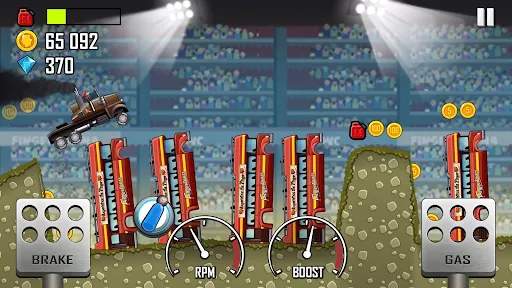
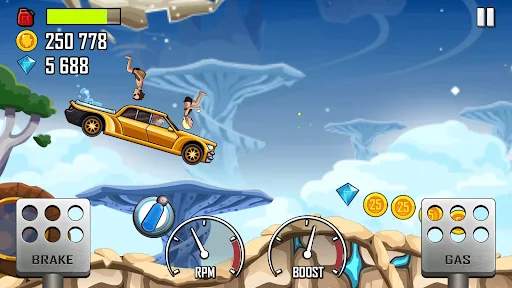
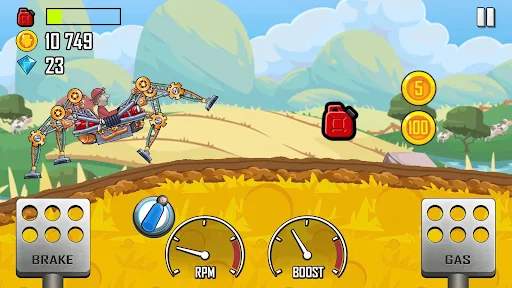
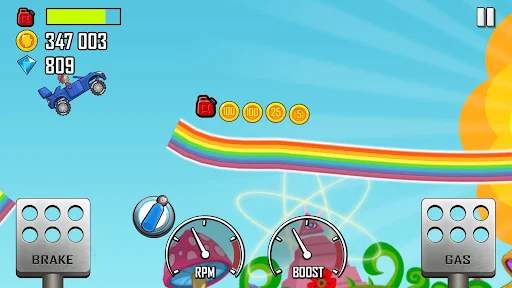
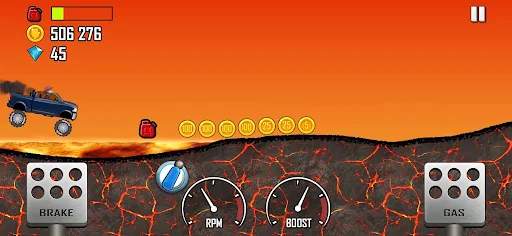
Another unique feature of Hill Climb Racing is that it balances humor and rigor. You know that in this world all kinds of unexpected accidents may happen, but you also know from the bottom of your heart that with better control, you can go further. The sense of improvement is real. After unlocking more vehicles, you will have a greater sense of satisfaction. With the coins collected, you can also improve the engine, suspension, and tires. At first glance, this looks like a standard numerical progression system, but in practice, it reshapes how you experience each vehicle. A car that initially feels heavy, unstable, and under-powered can become smooth and reliable after upgrades. Before upgrading, you struggle with it; after upgrading, you learn to control it. This process feels like taming an unruly machine rather than simply increasing numbers. In this world, each vehicle is different, not simply a better version of another vehicle. As for the maps, the countryside map is simple and ideal for learning controls. The desert and the moon significantly change how the vehicle handles, especially the low gravity on the moon, which almost creates an entirely new gameplay experience. Snow, caves, and highways each introduce different terrain patterns, resource placement, and visual pressure. Some maps put emphasis on maintaining rhythm over rolling terrain, others focus on managing risk during drops and landings, while some constantly force you to choose between high-reward routes and safer options.
Another highlight of the game is its micro-narratives. It does not have long traditional stories, but each driving round feels like a small journey. You start smoothly, collect coins, and build confidence. Then a steep hill or awkward landing pushes you into danger. You react instinctively, trying to stabilize the vehicle, grab the last fuel can, and gamble on a long descent. In the end, you might crash in a ridiculous way, or barely survive and continue. Every run has a beginning, development, turning point, and an end. When fuel runs low and the margin for error shrinks, the desire to go just a little further becomes very strong. This is why you just find yourself wanting to restart again and again because you are not just chasing distance, you are experiencing short but complete adventures. It does not rely on long periods of success, but on frequent and fair failures that push you to try again. Each failure makes you feel that you are so close to success. You ran out of fuel just before reaching the next stop. You landed at the wrong angle. You could have beaten your record with slightly better control. This small gap between failure and success is crucial. It turns frustration into motivation. Many highly replayable games depend on this design, and Hill Climb Racing handles it very well. Emotionally, the game is simple but addictive. Visually, the game has a simple, cartoon style that highlights its distinct style. The advantage is clarity, smooth performance, and minimal distraction. Instead, it reveals its quality over time.
From a broader perspective, this game turns intuitive physical instability into a skill system that players can engage within a long period of time. Many games pursue realism and end up becoming too difficult, while others prioritize entertainment but lack depth. Hill Climb Racing manages to strike a balance between the two. It makes you laugh while also letting you learn. It allows you to fail, and then improve. Overall, Hill Climb Racing is not defined by its scale, but by how refined its core loop is. It is simple, but not shallow; accessible, but not trivial. It may look like a casual game, yet it contains clear technical depth and emotional tension. It is not about how far you can drive, but whether you can drive a little better each time. And when a game makes players care about doing something well, rather than just finishing, it becomes more than just a way to pass time. It may not be the most ambitious driving game, but it is definitely one of the mobile games that best understands the relationship between feel, failure, and the desire to try again. In real life, you may often fall into a persistent lack of confidence. You may have tried various ways to fix it, such as reading, reflecting, using positive self-talk, even repeating "correct" ideas in your mind over and over again. But a very real problem remains: theory does not automatically translate into feeling. No matter how logically sound these abstract ideas are, without experience to support them, they rarely settle into a genuine sense of confidence. You may understand confidence, but you do not necessarily possess it.
What makes Hill Climb Racing distinctive is that, in an almost minimalistic way, it provides exactly this kind of experience. Mechanically, it is extremely simple: just throttle and brake, gravity and inertia, terrain and feedback. Yet it is precisely this simplicity that makes every outcome highly attributable. Failure is neither obscured nor diluted. When you crash, it is because of a specific mistake at a specific moment. You pressed the throttle too hard, released it too late, or failed to control the landing angle. The game offers no explanation, but it is never ambiguous. There is no explicit "leveling up," yet you begin to notice a shift: you pass the same terrain more consistently, you develop an intuitive sense of balance, and you can even anticipate and correct instability before it happens. This change itself becomes the source of confidence. It does not come from success alone, but from the realization that "I can make things better through adjustment." This realization is concrete, repeatable, and entirely grounded in your own actions. It is therefore fundamentally different from the kind of confidence built through language or self-persuasion; it is closer to a genuine sense of competence rather than a temporary emotional boost. More importantly, this sense of competence carries over. As you experience the cycle of failure, analysis, refinement, and trial and error again and again, you begin to internalize a new way of thinking: mistakes are no longer seen as proof of inadequacy, but as indications that strategy can be improved.
While this may seem confined to gameplay, it mirrors many real-life situations. The most important difference is that real life rarely provides feedback that is as instant, clear, and controllable. From this perspective, the value of Hill Climb Racing lies not only in the refinement of its design, but also in its ability to create a high-quality feedback environment with remarkably low barriers. Within this environment, you can fail safely, adjust quickly, and perceive your own progress within short cycles, which is an experience that is actually quite rare in real life. As you gradually build a stable belief that "I can get better through adjustment," this belief does not remain confined to the virtual space. It may not immediately transform your personality, but it subtly reshapes how you respond to difficulty: whether to default to self-doubt, or to keep exploring alternative approaches. Hill Climb Racing does not attempt to teach you how to be confident. In fact, it never directly addresses the concept at all. Yet through a system of clear, perceptible feedback, it allows you to personally experience how confidence is formed. And confidence built through concrete actions like driving is far more resilient than anything constructed through words. This, perhaps, is the deeper layer worth taking seriously beneath the simple surface!