Editor's Review:
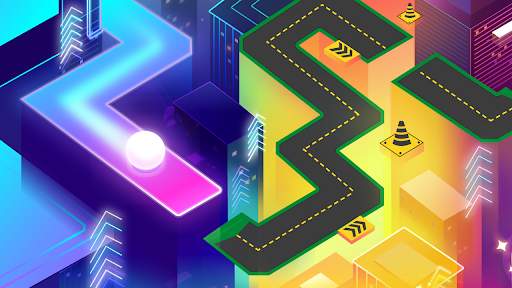
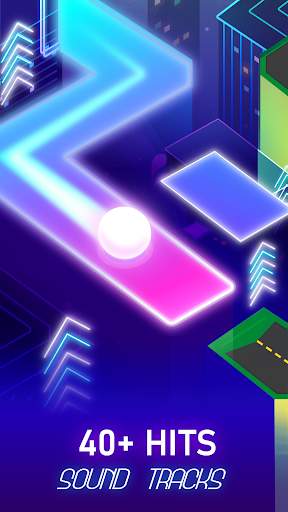
Dancing Ballz: Magic Tiles is a music rhythm game based on one-touch control, binding track-based reflex gameplay tightly to musical timing. Once you fully immerse yourself in this world, it becomes clear that it is not just a music game for you to listen to songs and tap along. What makes it interesting is the way it turns "hearing music" into "having your emotions caught by your body." The ball travels along a broken path on the screen, and although you seems to be merely making jumps at corners, what is actually happening is a constant process of confirming the beat, confirming emotion, and confirming whether you are still moving with the song's breathing. Many rhythm games chase spectacle, judgment precision, and visual overload. What stands out about Dancing Ballz: Magic Tiles is that it lets you enter an almost instinctive state of following. With the simplest motion possible, it allows you to tap out those feelings that are often hard to describe. Victor Hugo once said that, "Music expresses that which cannot be said and on which it is impossible to be silent." This line is especially fitting for Dancing Ballz: Magic Tiles. What makes this game moving is not that it tells you a song is "good," but that it lets you physically participate in the way the song enters your body. You are not an observer. You are the executor of rhythm, the carrier of emotion.
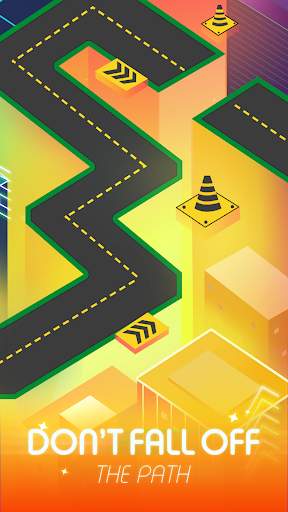
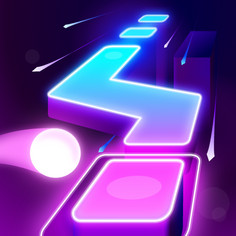
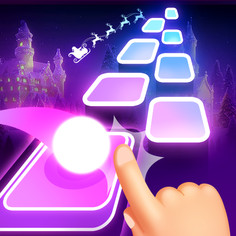
As for the gameplay, the rules are so simple that they are almost self-explanatory. The ball moves forward automatically. You only need to tap at each turning point so it continues along the path. Simple, yes, but not empty. All the tension comes from the synchronization between the music and the route. When a turn lands exactly on a drum hit or on the beat where the melody pushes forward, the action creates a beautifully satisfying sense of alignment. You do not clear a section because the system is generous. You clear it because you truly hit the beat. And that sense of being "right" is not just about quick reaction. It is about a brief but unmistakable trust established between your ear and hand. This is also what separates it from ordinary reflex-based runner games. Standard reaction games mainly test your visual anticipation, while Dancing Ballz: Magic Tiles demands a compound form of perception, which means you must watch the line, but you must also hear the rhythm; you must anticipate the turn, but also enter the melody. Precisely because of that, the game generates a very particular kind of immersion. You can translate all your feelings into the soundtrack and let it wash your negative emotions away. This "translation" is not a literary metaphor in the abstract. It is a concrete experience. When you are irritated, you want to press every corner more precisely. When you feel weighed down, chasing the beat strangely makes you more focused. And when a song ends, there is often a sensation of having been completely rinsed through by the music. It does not comfort you with lines of dialogue like a healing narrative game would. Instead, it drags you out of inner chaos through rhythm alone.
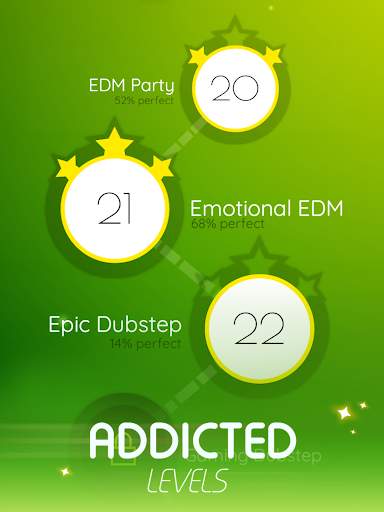
The song experience deserves special attention as well. Its song selection is not built entirely on the idea that unfamiliarity equals freshness. On the contrary, some tracks may already be familiar, yet once they are placed inside this jump-and-track structure, they become electrifying in an entirely new way. The sensation is fascinating because the melody carries familiarity, but the rhythmic propulsion gives it a renewed sharpness, as if the designer had eavesdropped on your internal dialogue and knew exactly where you needed to be pushed, lifted, or awakened, especially when a song reaches its chorus or an emotional swell. Your fingers enter a state that genuinely feels "plucked" by emotion, as if someone were strumming your feelings with their fingertips. Most importantly, this stimulation does not accumulate anxiety. It leads to release. After unlock more songs, the feeling is not "I finally survived that," but rather "I finally let that out." Those are two completely different emotional aftertastes.
From the perspective of skills, it does not erect a high barrier to entry. It does not require players to first master multi-finger inputs, hold-note judgment, or slide mechanics. Instead, it preserves the most direct entrance into music through extremely minimal input. That makes it especially suitable for players who carry a lot of emotion in daily life but struggle to express it. In real life, we often feel that we lack the proper tools or the right context to express the fullness of who we are and what we are feeling. But this game has a rare ability, that is, it can take all those scattered, heavy, complex, even unspeakable feelings and pull them into a single jump. A corner, a tap, a narrow success in staying on the line, each of these can make you relive the joy of having your emotions caught and held. It compresses abstract feeling into an action, then throws that action back into the music where it grows larger. In that sense, you are not merely "killing time," but repeatedly reenacting the process of having emotion safely placed somewhere. That is why, if you are the kind of person who is often haunted by negative feelings and finds it hard to shake mental noise loose, you should try Dancing Ballz: Magic Tiles. Not because it magically solves the problems of real life, but because it can restore a sense of flow within just a few minutes. When emotion gets blocked, the worst thing is stagnation. This game, by contrast, achieves relief through constant forward motion. The ball cannot stop. The music cannot stop. Your finger cannot stop either. Once you truly enter the rhythm, you can feel your attention being pulled away from those recurring negative thoughts and redirected toward the beat. At that point, the most accurate description is simply this: let your fingers dance. Not as a metaphor, but literally, your fingertips begin to move as if they are chasing your heartbeat.
Of course, the game is not without flaws. The underlying gameplay remains relatively singular. The core action does not change much, and after long sessions, players will gradually see the structure beneath it. No matter how the songs or tracks vary, the foundation is still corner-tapping. That singularity does not necessarily cause boredom, but it does limit how far the game can extend in terms of systemic depth. Even though it has its limitations, you will also find its real charm by changing your perspective. Looking at it more deeply, you will understand this game is not simply about "how fun it is," but how it redefines expression in rhythm games. Most players discuss rhythm games in terms of reaction speed, accuracy rate, hand speed, song libraries, skins, or difficulty curves. But what is most worth writing about in Dancing Ballz: Magic Tiles is that it returns expressive power to the player's body. You do not express yourself through a character, a plot, or a line of text. You express yourself through precision, hesitation, mistakes, recovery, and the act of chasing rhythm again. If your mind is unsettled on a given day, your play will drift. If you are focused, the ball seems to move along your nerves. In that sense, the game becomes an unusually honest mirror. What it reflects is not merely how technically skilled you are, but whether you are truly present with yourself in that moment.
That is why you cannot directly dismiss it as a mere casual mobile game. It certainly can be considered that way, but its best function is closer to that of a short-form emotional device. You can play one or two songs when pressure builds up, when you are irritated, or when your mind feels overcrowded. You may find that some games help you escape reality, but this one is better at filtering out the noise of reality and leaving behind only rhythm, motion, and a small rekindled flame of passion. Anyway, Dancing Ballz: Magic Tiles is neither a rhythm game that wins through complexity nor a casual music game that survives on superficial packaging. Its real value lies in the way it compresses musical emotion, bodily memory in the fingers, and the player's difficult-to-name inner life into a single line that never stops moving forward. It can be repetitive. It can be structurally limited. At times, it can feel insufficiently deep. But when it truly works, the experience it creates is still rare. When one song ends, it feels as though you have completed a brief but genuine reconciliation with yourself. That is its most professional and most humane strength. It not only gives you a chance to appreciate wonderful music, it also lets you truly get in touch with your inner world by fully immersing yourself in this music world!