Editor's Review:
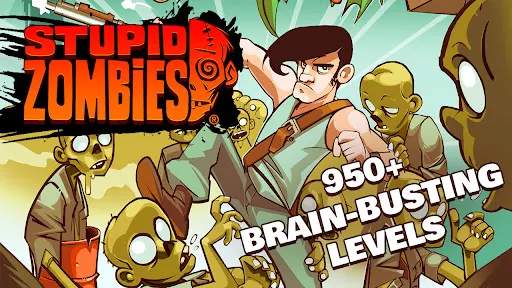
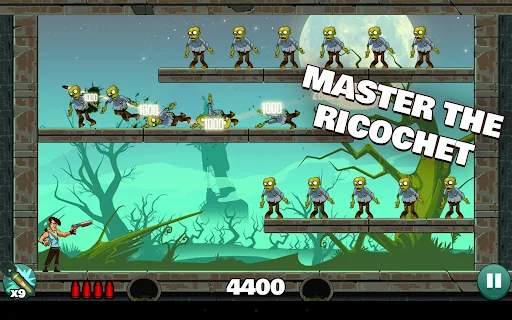
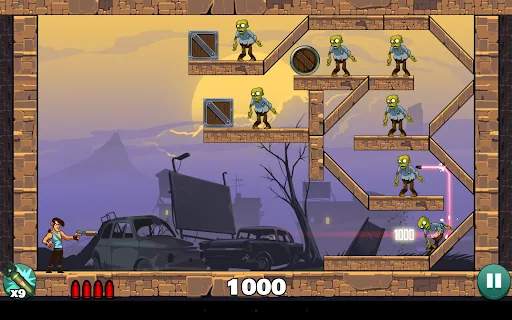
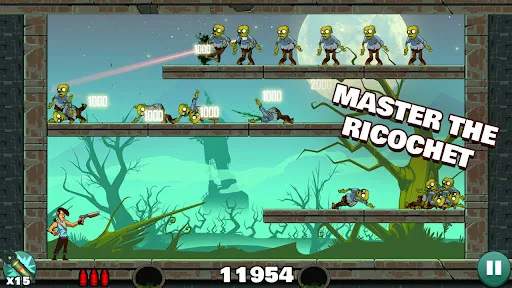
Stupid Zombies is a puzzle shooting game. It does not belong to that category of zombie games where you hold a machine gun and sweep across the screen. The core of its gameplay is to use a limited number of bullets, through penetration and rebound, to eliminate all zombies in the scene. As the ancient Greek philosopher Aristotle said in his work Metaphysics, "Wisdom comes not only from knowledge of things, but also from understanding of causes and effects". Every step of progress you make in this game is a deeper grasp of the relationship between cause and effect. You will absolutely fall in love with the feeling of piercing multiple zombies with a single bullet. When you adjust the angle, release your finger, and the bullet flies out of the screen, it first cuts cleanly through the head of the first zombie, then continues forward with its remaining speed, hitting a second and a third. Sometimes, it even bounces off a wall to finish off a fourth one hiding in a corner. The whole process flows smoothly and is completed in one breath. And the crisp popping sound that accompanies each kill feels like an instant reward for your action. It is short and clear, like the sound of a bamboo joint snapping, with no dragging at all. This sound design is very restrained. It does not roar in your ears. Instead, it lands perfectly in your auditory comfort zone, making you unable to resist wanting to fire another shot after every chain kill. You will find yourself silently counting, "One, two, three..." and then the corners of your mouth lift slightly. This feeling is something that those games relying on constant gunfire for excitement cannot give you.
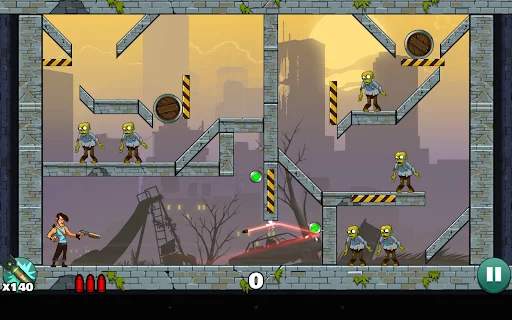
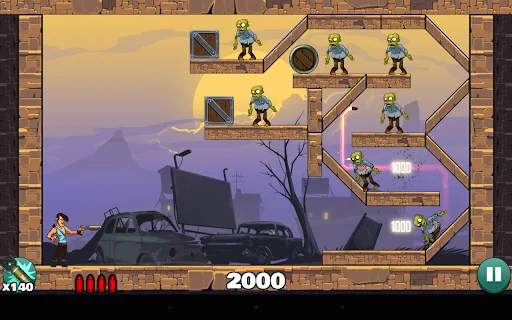
Killing all zombies is very easy at the beginning. The first ten levels feel more like an extension of the tutorial. The zombies are not densely placed, and obstacles are almost nonexistent. You only need a casual swipe to clear an entire level with ease. This brief period of ease is actually a carefully designed trap. It gives you the illusion that this game is nothing special. It lets you build up basic hand feel without any pressure, and then, just when you are full of confidence, it quietly pulls the rug out from under you. As you unlock more and more levels, you will find that obstacles begin to grow like spring weeds. Metal plates, wooden crates, ice blocks, and walls are no longer just decorations in the background. They become physical barriers standing between you and the zombies. You will discover that a level you could solve with one shot before now requires five or six attempts to find the correct angle. On your first try, you might only take down one zombie. On the second try, you find that you can use a wall for a rebound. On the third try, you realize that the wooden crate can be destroyed by the bullet. Every failure is not a true failure. It is a supplement of information. The game uses this layered difficulty design to force you to slow down your pace, shifting from mindless shooting to focused thinking.
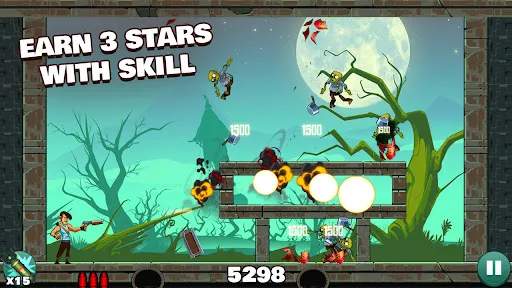
As you kill more and more zombies, you will feel yourself becoming increasingly powerful. This kind of power does not mean that your character has gained any buffs or that you have unlocked some overpowered weapon. It means that your perception, judgment, and spatial imagination as a player are systematically improving. Initially, you shoot as soon as you see a zombie, like a frog pouncing on a flying insect. Later, you learn to observe before acting. The entire scene becomes a map in your mind on which you can mark paths. You start to predict the trajectory of the bullet. You begin actively looking for angles that allow a single shot to kill multiple targets. You develop muscle memory for the rebound angles of walls. In some levels, you even unconsciously use your hands to trace the flight path of the bullet. Later in the game, you will realize that this game is not about blind shooting. It is more about your strategy. Each level is a geometric puzzle, and the bullets in your hand are the only tools for solving it. Before you shoot, you may ask questions like, "Which zombie should I kill first? Which zombie is best positioned to serve as the starting point of a chain reaction? After the bullet penetrates the first target, does it have enough remaining speed to reach the next one? Is the rebound path off the wall clear enough, or will it be intercepted by other obstacles along the way?" In some scenes, you even need to decide whether to sacrifice a bullet on purpose to destroy an obstructive crate. This is a strategic trade-off based on resource management. The game does not tell you what the optimal solution is. It only hints that there is room for improvement through its three-star rating system. You will find that your brain gradually adapts to this way of thinking. You are not just playing a game. You are solving problems. When you finally clear a level with a single bullet, a level that originally required three bullets, you will experience a pure intellectual satisfaction.
If you have some knowledge of physics, you will perform better in the game. The most direct application is the law of reflection. When a bullet hits a flat wall, the angle of incidence equals the angle of reflection. You do not need to draw guide lines on paper, and you do not need to remember any complex formulas. But if you have a certain intuition about this law, your aiming speed will be noticeably faster than that of players who rely entirely on feeling. When facing a zombie hiding behind a wall, you will quickly estimate a rough reflection point in your mind and then pull the trigger decisively. Another frequently overlooked piece of knowledge is momentum. After a bullet passes through a zombie, it loses some speed. This means its range becomes shorter and its penetration power decreases. If you take this into account when planning a multi-target chain, you will avoid the embarrassment of aiming at a third zombie only to find that the bullet stops halfway. In the game, there is a type of level that deliberately places floating ice blocks on water as ricochet platforms. In these cases, a little understanding of friction and inertia will help you judge more accurately whether the bullet can continue forward after breaking the ice.
From the perspective of overall design, there are some easily overlooked merits of this game worth pointing out. The size of its levels is controlled very precisely. Each level is short enough that you can complete one attempt in the time it takes to wait for an elevator, yet deep enough that you are willing to challenge a specific angle more than a dozen times. The cartoon visual style of the game also serves as a good emotional buffer. The zombies look clumsy and even a bit cute. The animation when they are hit is soft, with no gore at all. This means you can play the game with confidence in public places without worrying about making people around you uncomfortable. In addition, the sound design of the game is quite restrained. It does not use intense background music to create tension. Instead, it leaves the auditory space for the sound of the bullet and the sound of kills, making every crisp echo a direct response to your judgment. In summary, Stupid Zombies is a puzzle shooting game that sees the big from the small. It uses the simplest rules of shooting, penetration, and rebound to build a game world that offers both satisfying feedback and deep strategy. You will enjoy the thrill of chain kills accompanied by crisp popping sounds. You will sharpen your patience and judgment in increasingly complex levels. You will feel genuine growth after each successful completion. It will transform you from a beginner who shoots wildly into a strategist who never misses. And if you happen to have some knowledge of physics, you will find that your advantage is subtly activated. When you eliminate all zombies with a single bullet in Stupid Zombies, what you gain is not only the joy of victory but also a confirmation of your own way of thinking!