Editor's Review:
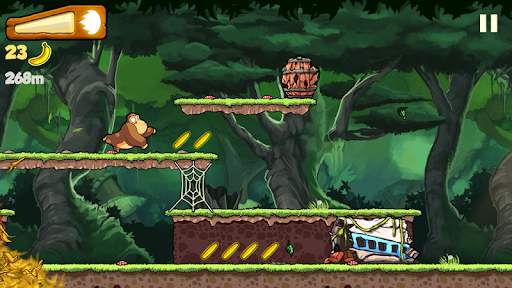
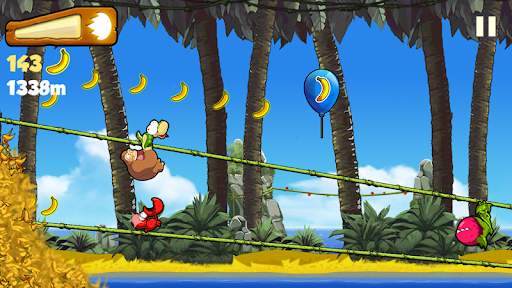
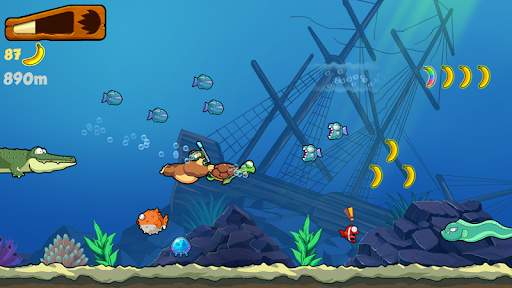
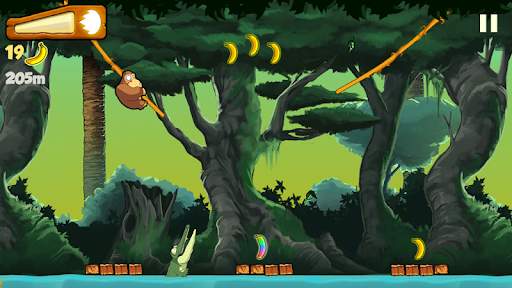
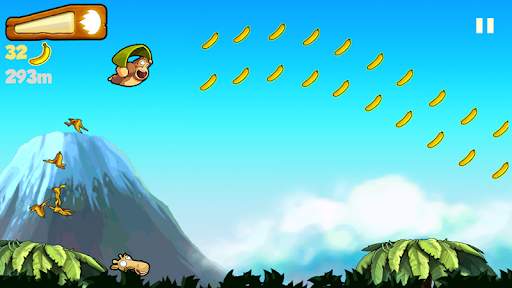
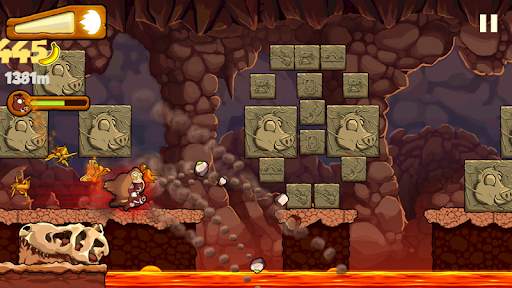
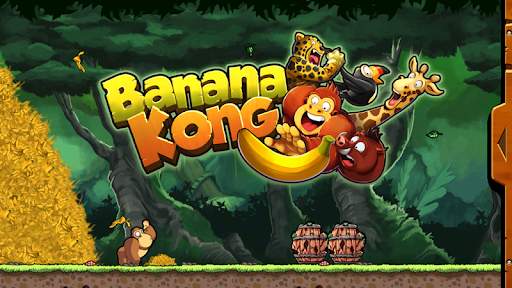
Banana Kong is an endless running game. Many running games only focus on rhythm, reflexes, and immediate pleasure, yet what makes Banana Kong special is that it almost never leaves room for emotional stagnation. The moment you begin to run, the banana avalanche behind you, the constantly shifting terrain ahead of you, and the layered dangers in the air and on the ground immediately turn you from a spectator into a participant. There is no space for hesitation and no relaxed mood of watching first and acting later. Every second, you make a decision, and every second, you bear the consequence of that decision. Because of that, what it gives you is not passive entertainment, but a highly active experience of play. Obviously, the controls are not complicated. You only need tap to jump, hold to glide, swing with vines, and use mounts such as the rhino or the ostrich to rush through certain stretches. The rules are easy to understand at a glance. However, once you truly begin to chase distance and scores, you notice how complete this system really is. It does not create depth by piling up buttons. It creates layers through speed, distance judgment, and combinations of terrain. Every jump requires you to estimate the landing point. Every glide forces you to weigh the loss of height. Every time you enter a cave, a water section, or a route above the trees, you are adjusting to a new rhythm. So, this game requires a great deal from your reflex habits, the stability of your hands, and the continuity of your judgment. This demand does not make you feel tired. On the contrary, it keeps you motivated, because the design is smart enough not to drag you into meaningless frustration and not to hand high scores to you easily. You always feel that one more run could carry you farther.
This feeling that you are always motivated is one of the greatest strengths of Banana Kong. Many similar games rely on mission lists, plot progression, or numerical growth to keep your attention. Banana Kong relies on immediate feedback. The moment you complete a beautiful sequence of actions, the continuation of speed, the collection of bananas, and the successful crossing of terrain immediately answer you. The moment you stabilize your rhythm on the edge of danger, the next section of the map offers a new challenge. Even if you make a mistake, restarting is so fast that negative emotion is not prolonged, and your focus is not broken. It does not drag you away from the core play through complicated menus in the way many similar games do. Instead, it keeps pushing you back into the act of running itself. You stay full of hope because every failed run seems to say that you are not incapable, but that you are very close to grasping the rhythm.
From the psychological experience, the most interesting new angle of this game is not merely that it is exciting, but that it naturally fits the structure of flow. Mihaly Csikszentmihalyi once said that, "The best moments usually occur when a person's body or mind is stretched to its limits in a voluntary effort to accomplish something difficult and worthwhile". In this world, your goal is always clear. The feedback is immediate. The difficulty keeps changing, yet it never fully leaves the edge of your ability. It never feels so hard that it turns chaotic. Instead, it keeps you in a place where complete concentration is always necessary. As a result, you naturally enter a state of flow. While you run, outside noise begins to matter less, the sense of time weakens, and the awareness of self gradually recedes. What remains is the synchronization among your fingers, your eyes, and your anticipation. This feeling of total absorption is something that will attract your attention. What is even more valuable is that this concentration is not the tense concentration of anxiety, but a kind of calm within movement. You feel excited, but not panicked. You feel pressure, but not stiffness. There is a very natural coordination among the background music, the movement of the character, and the transitions of terrain, so that while you are moving at high speed, you enter something close to a Zen like mental state in motion. Especially when you pass through several different zones in a row without error, you enter a rare state of immersion. You are no longer thinking about breaking a record, and you are no longer fixated on not dying this time. You simply continue to run, continue to dodge, and continue to catch each rhythm as it arrives. At this point, almost nothing can disrupt your concentration, because the game has already drawn you into its own sense of time. Many similar games try to create immersion through spectacular presentation. Banana Kong creates immersion through simplicity and speed, and that is a rarer feature.
This game will also teach you something about true optimism. In real life, many people are forced to maintain optimism, as if they are only allowed to look at the bright side. Over time, that kind of positivity becomes hollow and sometimes even oppressive. In the world of Banana Kong, however, the positivity that emerges is completely different. You do not gain strength by pretending that there are no obstacles ahead. On the contrary, you gain strength precisely because you keep moving forward while clearly seeing every obstacle in front of you. Logs block the way, deep gaps are lethal, crocodiles and flames do not disappear simply because your mindset is positive. This game does not lie to you by saying that the world is friendly. It simply returns control to you. Danger exists objectively, but you can jump over it, slide past it, and time your movement well enough to cross it. This kind of positivity is not self-hypnosis. It is a kind of positivity built on real action. You do not avoid difficulty. You move straight through difficulty again and again with courage and caution, and because of that you gain the conviction that you can handle it. That is why the feeling it gives you is not cheap comfort, but real empowerment.
From the perspective of long-term play, another mature quality of Banana Kong is that it makes you want to conquer it alone instead of constantly searching for help from the system. It does not place the center of its design on dependency upon guides. What you truly improve is your own sense of rhythm and your own familiarity with the game. You naturally refuse shortcuts, because what attracts you is not only the result but the feeling of mastering the process. You begin to remember how far in advance you should jump before a certain type of broken ledge, how to estimate the arc of a particular vine swing, and how to use the collision advantage of a mount to increase tolerance in certain sections. This learning is not the memorization of patterns in a mechanical sense. It is a bodily understanding that forms through repeated practice. So Banana Kong may not be the most complicated running game, but it is very likely one of the games that best understands how to keep you moving forward and make you feel that you are becoming stronger. It reminds you that a truly good running game does not merely make the character keep running. It makes you realize that as long as you keep running, you are still alive, still focused, and still moving ahead!